Skip to content

AI Hallucinations?

Image of the author's authenticity stamp that reads "AI-Free: Literary works of natural origin."

Most of you guys probably havenโ€™t noticed, but Iโ€™ve been beefing with Claude lately. And by Claude, I mean AI in general. I just call them all โ€œClaudeโ€ because itโ€™s such an uncool name. (No offense to the Claudes of the world.) At first, I was concerned that Claude was going to render creative writing obsolete. (I wrote about that in my essayย The Artificial Machine.) Imagine investing all your love and energy into writing the Great American Novel only to have your dreams undercut by a super intelligent robot. Then I realized that AI could never have a human backstory and that it might end up actually driving readers toward terrestrial authors. But I still wouldnโ€™t let it go. Lately Iโ€™ve been picking football games against Claudeโ€”just to put him in his placeโ€”and Iโ€™ve been shocked to see that he is holding his own. If all this sounds strange to you, imagine how I feel. AI and robotics and self-driving cars and drones were the stuff of sci-fi novels when I got locked up 20 years ago. Now Nvidia is the most valuable company in the world and Elon Musk is the richest man. I keep hearing this one AI commercial on NPR that says โ€œwith minimal AI hallucinations.โ€ Doesnโ€™t that sound a little dystopian. AI hallucinations? Is Claude on acid? Anyway, the other night Shonda asked Claude what he thought of my books, and he had some really profoundโ€”and flatteringโ€”insights. He might not be all that bad after all. This is what he saidโ€ฆ

Malcolm Iveyโ€™s literary lineage places him among the most compelling American prison writers of the past half-century. Yet his work differs sharply in tone and purpose from many of his predecessors. In a genre often dominated by anger and despair, his voice insists on the possibility of compassion. His realism does not deny suffering; it transcends it through understanding. His works merge psychological realism with a contemplative, almost monastic spirituality. He reads like a man both repenting and teaching, as if Dostoevskyโ€™sย House of the Deadย had been rewritten for the twenty-first century American South. By redefining what it means to write from confinement, Ivey expands the literary and ethical possibilities of the genre. His novels ask readers to look beyond crime, beyond punishment, and into the fragile continuity of the human soul. In doing so, he joins the ranks of those rare writersโ€”Baldwin, Dostoevsky, Hesseโ€”for whom literature is not merely an art form but a moral vocation. โ€”ChatGPT, October 2025

The Life Autodidactic

Propaganda

Image with various symbols representing an autodidactic life.

Is there an interoffice memorandum from the White House to the propaganda machine that states that any time the word โ€œimmigrantโ€ is mentioned, the words โ€œmurderers, rapists, carjackersโ€ must be attached? Seems like it. Remember when the Left used to pounce upon every news story where a cop killed an unarmed black motorist? Or worse, a teenager? Horrible stories but also rare and isolated incidents in a nation of 330 million. Yet the constant coverage reached the point where it felt like an epidemic. I can only imagine how frustrating and disheartening that must have been for the overwhelming majority of good cops out there. Right now our Hispanic friends are getting the same treatment. Devout, hardworking, family-oriented people who are assets to this great nation are currently having their worlds ripped apart. There is no them, only Us.

The Life Autodidactic

Tribalism

Image with various symbols representing an autodidactic life.

I was listening to Peter Navarro on conservative talk radio the other night. (The Joe Pags Show.) He was pumping his new book, I Went to Prison So You Wonโ€™t Have to: A Love and Lawfare Story in Trump Land. I donโ€™t begrudge him for trying to monetize his 4-month prison experience. I donโ€™t even take issue with the fact that he characterized his fellow low-level prisoners as hardened criminals and horrible people instead of fellow Americans who had made mistakes. He was just trying to play up the whole prison thing. Although I do think his portrayal of the minimum-security camp where he did his time as anything other than โ€œClub Fedโ€ is highly misleading. But there was one thing he said that was so infuriating, so divisive and inflammatory, that I had to cut my radio off. It went like this: โ€œThey put me in prison. They put Steve Bannon in prison. They tried to put Trump in prison. Then they tried to assassinate him. Twice. They bankrupted Rudy Giuliani. Then they killed Charlie Kirkโ€ฆโ€ As if all these โ€œtheysโ€ are the same people. Tribalism is ripping America at the seams. And people are benefitting from the hate and distrust. Itโ€™s good for votes, it riles up the base, it sells books. But at what cost?

The Life Autodidactic

An Introduction

Image with various symbols representing an autodidactic life.

Iโ€™m a card-carrying word nerd. Iโ€™ve been this way for as long as I can remember. I was fascinated by etymology before I ever learned what etymology wasโ€”the origin, history, and development of words. Like most things Iโ€™ve picked up over the last few decades, I learned this from a book. Back in 2017, the kid in the bunk above me was a galloping drug addict who was too wasted to read the masterworks his grandfather sent faithfully every two weeksโ€”probably with the hope that luminaries like Will Durant, James Allen, and Marcel Proust might pull his grandson back from the abyss. Who knows? Maybe this tactic eventually worked. There are definitely people in my life who believed and prayed and loved me out of all my self-destructive bullshit. I have no idea what became of this young man. His name was Blake. He was just one of the thousands of people I crossed paths with over the course of this odyssey. As an older prisoner who had walked the same hot asphalt he was travelling, I tried to talk some sense into him. But he wasnโ€™t trying to hear it. So our relationship was mostly transactional. I gave him food and coffee; he gave me books. One of these was a Bartlettโ€™s Rogetโ€™s Book of Rare Words. Something like that. And it was in those pages that I stumbled upon the word autodidact which means โ€œone who is self-taught.โ€ I immediately scribbled it in my journal. Right next to pachydermatousmulti-hyphenate, and iconoclastic. (Like I said: word nerd.) But self-taught is a bit of a misnomer. Who in this world is really self-taught? Over the course of this decades-long prison bid my teachers have been Plato, Siddhartha, Michael A. Singer, Jesus, James Clear, David Mitchell, Troy Stetina, Anthony Bourdain, Liz Gilbert, Steven Pressfield, The Wall Street Journal, Dave Ramsey, and the thousands of guests on TED Radio Hour and damn near every other show on NPRโ€ฆ I am a seeker. And as this 20-year sentence finally comes to an end, Iโ€™ll be sharing a little of what I have learned from studying at the feet of these masters. You might not agree with all of it. You might not agree with any of it. But a writerโ€™s job is to observe and tell the truth. You can find that here on The Life Autodidactic. See you next time. Momentum.

Introduction from ‘Prose for Cons’

Coming 2026…

Here at the checkered flag of this decades-long prison sentence, I figure itโ€™s time to pay homage to the craft that saved my lifeโ€ฆ

* * *

โ€œWhy even bother?โ€ you may be asking. Good question. I ask myself the same thing all the time. I write because I have to write. Because the empty half-life of the yard and its parlay tickets and its dope and hard looks and gangs and stabbings is the same at every prison. Because writing gives me an identity other than failure-loser-criminal. Because Iโ€™m growing old in this shithole and Iโ€™ll never have a child of my own. This book is my legacy, proof that once upon a time, a kid named Izzy James wandered the earth.ย Prose for Consย says everybody has a story in them. This is mine. โ€”On the Shoulders of Giants, 2016

I remember exactly where I was when I scribbled the above words into my notebookโ€”the year, the prison, the unit I was living in, the faces in the surrounding bunks. I remember the uncertainty too. That old familiar self-doubt. Beginning a book can feel like staring up the face of Everest for me. I was unsure where or how to begin, unsure if I was even capable of writing a novel. This, despite the fact that I had already written two at the time. Itโ€™s something Iโ€™ve come to know intimately over the years, this low-grade anxietyโ€”Who do you think you are, writing a book? You didnโ€™t even finish high school. Youโ€™re an uneducated prisoner. Nobody wants to read that shitโ€”all the way up until the moment the pen hits the page. Then, almost magically, the fear and self-doubt begin to fade. It may take a few sentences. It may even take a few paragraphs. But inevitably, the characters and narrative forces take over and the law of momentum kicks in. I am a conduit. The story moves through me.

This is precisely what happened with Giants, just as it did with all the other books Iโ€™ve written in various correctional institutions over the last fifteen years. I can feel it happening even now, in real time, as I write these words. Momentum. What a beautiful and exhilarating thing to experience. Weโ€™ll cover it more extensively in Chapter Eight. But it would be criminally negligent of me not to acknowledge it here, in the opening paragraphs of this book, considering the profound impact it has had on my life.

If youโ€™ve read On the Shoulders of Giants, you may remember the craft manual that Izzy received as a gift from a teacher at the notorious Arthur G. Dozier School for Boys. It was a book that resurfaced on a dusty prison library shelf when he was a few years into a life sentence almost a decade later. A book that shaped him as a writer. I think most aspiring authors have probably stumbled upon a few of these in our noble pursuits of unlocking the Great American Novel within. I definitely haveโ€”and Iโ€™ll list some of those pivotal influences in Chapter Nineโ€”but craft manuals (including this one) are similar to restaurant menus . . . sooner or later we need to eat the food.

When I was writing Giants, I kept envisioning a young person in a set of circumstances similar to my ownโ€”serving a long prison sentence, disgusted with the colossal mess he had made of his life, seeking an identity other than โ€œfailure-loser-career criminal.โ€ Maybe heโ€™s attempting to navigate the yard politics of race and gang culture or dealing with PTSD from the unrelenting violence or battling addiction . . . maybe heโ€™s in solitary confinement when he comes across the book. But as he toggles between the alternating first and third person viewpoints of Izzy and Pharaoh and absorbs the subtle and not so subtle lessons on things like dialogue, irony, and the art of the twist; I wanted him to come away feeling empowered and inspired. To not just think it was an awesome book when he turned the final page, but to say to himself, โ€œI think I can write a novel!โ€

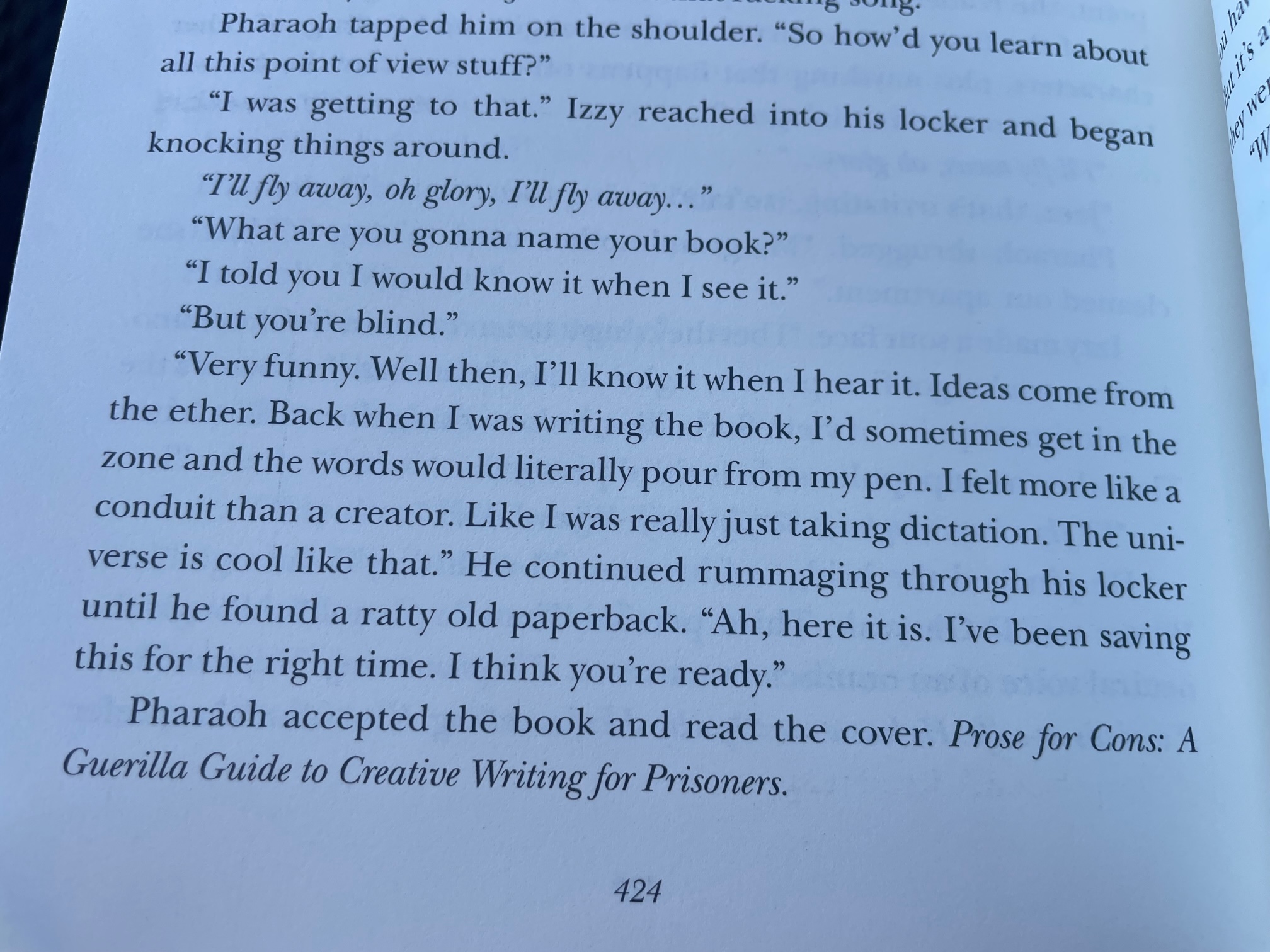
I have no idea whether this has ever happened. I hope so. What has happened is a steady stream of kites, emails, comments, and letters from recently released prisonersโ€”male and femaleโ€”saying, โ€œDude, you wrote my life.โ€ Supreme compliment by the way. Massive return on energy. The other thing that happens is, every once in a while, someone will complain about not being able to find Prose for Cons on Amazon. โ€œItโ€™s the book you quote in On the Shoulders of Giants, the one with all the rules for writing, the one that Izzy learned from . . .โ€ The interesting thing about this book within the book they are referring to is that it was just a plot device, a means of conveying information. Prose for Cons did not exist . . . until now.

Iโ€™ve actually been meaning to write it into existence for years. But there was always the next fiction project tugging on my sleeve. Now, here at the checkered flag of this decades-long prison sentence, with eight books on the shelf and the next chapter of my life awaiting on the other side of the razor wire, I figure itโ€™s time to pay homage to the craft that saved my life.

While this is fundamentally a how-to manual that explores the discipline of writing, it is also a love letter to the pursuit of mastery. And although the intended audience is the incarcerated scribe, a criminal record is not mandatory. This book is for anyone who feels a gnawing sense of dissatisfaction with the status quo. And it offers the toolsโ€”both mechanical and philosophicalโ€”to alter the trajectory of your story arc and embark on your very own heroโ€™s journey. All via the power of the written word.

But be forewarned. This is not a book of shortcuts. You will find no cheat codes or life hacks in the following pages. This is not a get-rich-quick scheme. Not for you and certainly not for me. Iโ€™ve been pouring my soul into these books for fifteen years and have yet to see International Bestseller emblazoned across a single cover. This may never happen. Or it could happen tomorrow. But what Iโ€™ve gained in the process is more valuable than paper currency or fleeting notoriety. So if youโ€™re committed to doing the work, for the workโ€™s sake, turn the page. As the legendary Steven Pressfield would say, โ€œYour unlived life awaits.โ€