The Black List runs an ongoing series called “Why We Write” in its Substack publication, Establishing Shot. There, writers share what made them writers and what keeps them writing. This week they published an essay I wrote about my own beginnings as a novelist and the process that has been with me through 15 years of writing.
Greetings, my friends. Long time, no essay. I have been uploading lots of videos but that doesn’t count. Not for us self-proclaimed scribes and practitioners of the time-honored craft of the written word. Writers write. No way around it. And if I’m not writing, then how long can I continue to call myself a writer?
For me, writing is life or death. The difference between freedom and a prison cell, clarity and chaos, the blue-sky future and the hellscape of my past. “Writing gives me an identity other than failure/loser/career criminal” declared Ezra James in the prologue of my third novel, On the Shoulders of Giants. But like many fictional characters, Izzy was just serving as an avatar for the author’s intrinsic beliefs. Back then I was putting in work, stacking up coffee-stained and ink-blotted pages, living in that ethereal realm known as flow state. Not so much these days. Currently, my prefrontal cortex is absorbed with learning technology after decades in the joint, reconnecting with family, acclimating to the world on this side of the razor wire. It’s not a bad life. I’m free. I’m home. I’m grateful. But I’m not writing. And again, if I’m not writing, then how long can I continue to call myself a writer?
This question has been gnawing at me lately. While working a 12-hour-a-day landscaping job in the Florida humidity, then coming home and staying awake long enough to eat, bathe, and dick around on my guitar for a few minutes before passing out. Only to rise before the sun the next day and do it all over again. All the while, this shiny new MacBook is just sitting here across the room, eyeing me resentfully. Like a jilted lover. Or worse, like a lover whose partner has suddenly developed erectile disfunction.
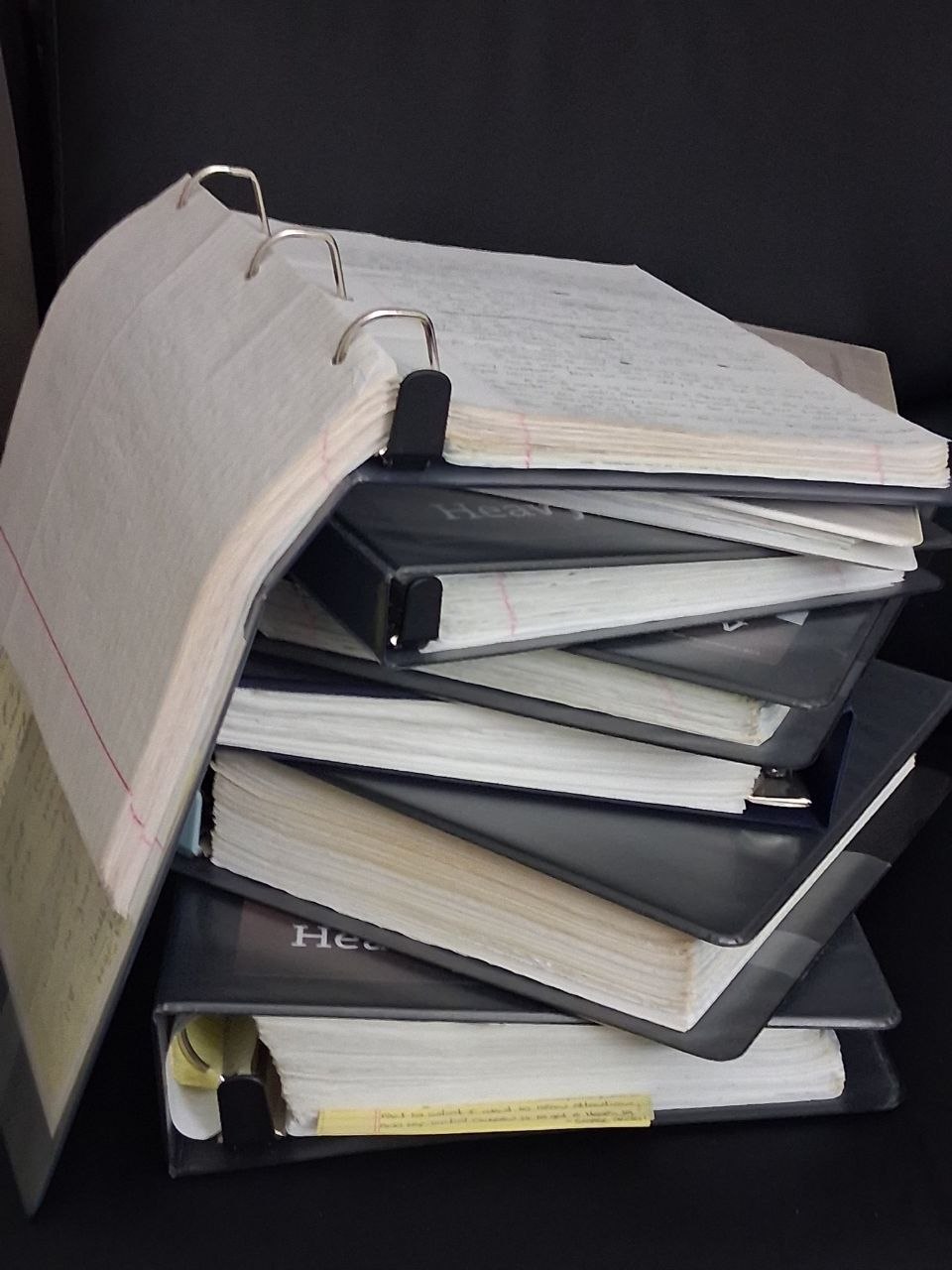
If you’ve read my other essays or books, you know that everything I’ve written was achieved longhand in my cell. Day after day, year after year, this pen and quill approach was the central focus of my life. My locker was stuffed with composition books, legal pads, thesauruses and craft manuals. I had no other option. But guys who were serving shorter sentences than me used to tell me how much I was going to love writing on a computer when I got out. Now here I am, nine months after walking through the gothic gates of FCI Terre Haute and out into the bird-chirping sunshine of the free world… and I haven’t written squat.
That changes here and now.
Yes, my time is limited and there are way more distractions to navigate out here. True, I no longer have countless hours to agonize over the perfect word or pithy sentence. And on top of all that, everyone seems to be a writer or essayist these days, thanks to AI. None of this matters. I have work to do, questions that require a fair hearing, stories to tell, a world to change. It all comes down to carving out time and harnessing will.
There’s a quote that I memorized early in my writing journey. I used to repeat it like a mantra when I was writing Consider the Dragonfly. Fifteen years later, I’m still busting it out to anyone who will listen. To aspiring incarcerated authors, to my coworkers on the landscaping crew, even to the 5th graders up in Michigan I had the honor of speaking to at the end of the school year. It’s attributed to a 19th century author named Anthony Trollope who worked for the British Post Office but awoke before dawn each morning to write for an hour before galloping off to his day job on horseback.
“The smallest task, be it done every day, will trump the efforts of a spasmodic Hercules. It has the force of the drop of water that hollows the stone…”
Such a potent observation. It’s time. Time to get back to the basics. Time to do the work. Time to liberate these thoughts from the solitary cell of my skull. Time to be that persistent drop of water that hollows the stone.
“The imagination, like certain wild animals, will not breed in captivity . . .” George Orwell, author of 1984, wrote these words. And while Mr. Orwell was damn near clairvoyant when it came to the dystopian future and the rise of the totalitarian state, I have to disagree with him on this point.
I’ve been living in captivity for most of my adult life and writing books from cramped cells and steel bunks for the last 15 years. During the most bleak and psychologically oppressive periods of this journey, it was my imagination that kept me company and filled me with hope. Without my imaginary friends and the parallel worlds they inhabit, I’d be crazy by now. “Nuttier than squirrel shit,” as a character from one of my first books once said.
Now that I’ve arrived at the dwindling hours of a 7,550 day odyssey that began in March of 2005 and wound its way through eight books, six presidential terms, and half the prisons in the Florida Panhandle to the crumbling Indiana federal dungeon where I sit drafting this finalE=mc2 newsletter on a November afternoon in 2025, it seems like a good time to allow myself to let off the gas and peek in the rearview.
When I began writing my first novel, Consider the Dragonfly, in early 2011, the Florida Department of Corrections was the most dysfunctional prison system in the U.S. Its aging institutions were understaffed, unairconditioned (they still are), teeming with scabies and staph, oblivious to basic human needs like nutrition or even a reliable supply of toilet paper, and rampant with abuse. I had recently finished serving nine months on 24-hour lockdown for an alleged relationship with a staff member. I weighed 132 pounds and was having major breathing difficulties even though I quit smoking while I was in the hole. For some reason, that deep satisfying breath that I had taken for granted my entire life was suddenly elusive. I was convinced it was asthma or COPD, but after checking my blood oxygen level repeatedly and finding nothing wrong, the nurse told me it might be anxiety. In hindsight, this makes total sense. Especially considering the conditions.
What made me want to write a book in the first place? I’m not sure. I have numerous theories—and I’ve mentioned most of them in various essays over the years—but no concrete answers. Here are a few of the greatest hits:
Age 40 was rapidly approaching and I had nothing to show for my time on Planet Earth—no kids, no property, no retirement account . . . just a criminal record dating back to the juvenile justice system in the late ’80s.
I spent my whole life breaking mom’s heart and letting her down. I wanted to give her something to be proud of.
I was a musician with no instrument. No guitar. But the creative impulse within me could not be suppressed and ended up working its way out through fiction.
Similar to the character of Izzy in my third novel, On the Shoulders of Giants, I was seeking an identity other than failure, loser, career criminal.
I grew tired of writing unanswered letters to disinterested people, so I decided to write the world a letter in the form of a book.
All of these motivations are true. Then and now. In 2024’s Letters to the Universe, I offered a more metaphysical explanation:
There’s a passage near the end of Liz Gilbert’s magisterial Eat Pray Love where she riffs on a Zen school of thought regarding the oak tree. In her retelling, the mighty oak is brought into being by two separate forces at the same time: the obvious one, the acorn, but also something else—the future tree itself which wants so badly to exist that it pulls the acorn into being.
All those letters, all those years. All of the working and reworking of sentences and paragraphs, trying to make them sing, replacing weak verbs with more robust options, attempting to convey humor, expanding my limited vocabulary, learning to write like I talk . . . Maybe what I was actually doing was finding my voice, shaping it, sharpening it, letter by letter, year after year. Maybe, like Liz Gilbert’s mighty oak, a grizzled fifty-year-old convict and multi-published author was pulling his twenty-year-old self forward, willing him to “Grow! Grow!” all this time.
And so, with the centrifugal pressure of all these forces pushing and pulling and swirling and gathering inside of me, as well as all the fear and suffering and violence surrounding me, I sat down on my bunk, put in my headphones, and began to write the story of CJ McCallister. I had no idea what I was doing. But I did it every day. And slowly, the characters stirred to life. Mom had recently retired after 40 years of administrative assistance in those days and was thrilled that I was doing something with my time other than chasing dope and running parlay tickets. When I asked if she would type my handwritten pages, she agreed without hesitation. But I doubt she ever imagined that this single question would define the next fifteen years.
Ever since that day, I’ve been stuffing pages in envelopes, six at a time, and sending them home. A week or two later, they return to me typed and double-spaced in Times New Roman font and sandwiched between Miami Dolphins articles and letters about the birds in the backyard. This is still happening today, even though mom is nearing 80 years old and I’m a couple weeks away from going home. In fact, I just received the latest installment of Prose for Cons in the mail last night.
Process. In James Clear’s Atomic Habits, he notes, “You do not rise to the level of your goals. You fall to the level of your systems.” This system that we installed 15 years ago is still humming along today. It’s a system that turned adversity into hope, and weakness into strength. Six pages at a time. There’s a lot of talk in writer circles about AI replacing human authors. But the journey of how these particular books were written could never be replicated by a machine. The next time you hold a Malcolm Ivey novel in your hands, I hope you will remember this.
Is there an interoffice memorandum from the White House to the propaganda machine that states that any time the word “immigrant” is mentioned, the words “murderers, rapists, carjackers” must be attached? Seems like it. Remember when the Left used to pounce upon every news story where a cop killed an unarmed black motorist? Or worse, a teenager? Horrible stories but also rare and isolated incidents in a nation of 330 million. Yet the constant coverage reached the point where it felt like an epidemic. I can only imagine how frustrating and disheartening that must have been for the overwhelming majority of good cops out there. Right now our Hispanic friends are getting the same treatment. Devout, hardworking, family-oriented people who are assets to this great nation are currently having their worlds ripped apart. There is no them, only Us.
I was listening to Peter Navarro on conservative talk radio the other night. (The Joe Pags Show.) He was pumping his new book, I Went to Prison So You Won’t Have to: A Love and Lawfare Story in Trump Land. I don’t begrudge him for trying to monetize his 4-month prison experience. I don’t even take issue with the fact that he characterized his fellow low-level prisoners as hardened criminals and horrible people instead of fellow Americans who had made mistakes. He was just trying to play up the whole prison thing. Although I do think his portrayal of the minimum-security camp where he did his time as anything other than “Club Fed” is highly misleading. But there was one thing he said that was so infuriating, so divisive and inflammatory, that I had to cut my radio off. It went like this: “They put me in prison. They put Steve Bannon in prison. They tried to put Trump in prison. Then they tried to assassinate him. Twice. They bankrupted Rudy Giuliani. Then they killed Charlie Kirk…” As if all these “theys” are the same people. Tribalism is ripping America at the seams. And people are benefitting from the hate and distrust. It’s good for votes, it riles up the base, it sells books. But at what cost?
I’m a card-carrying word nerd. I’ve been this way for as long as I can remember. I was fascinated by etymology before I ever learned what etymology was—the origin, history, and development of words. Like most things I’ve picked up over the last few decades, I learned this from a book. Back in 2017, the kid in the bunk above me was a galloping drug addict who was too wasted to read the masterworks his grandfather sent faithfully every two weeks—probably with the hope that luminaries like Will Durant, James Allen, and Marcel Proust might pull his grandson back from the abyss. Who knows? Maybe this tactic eventually worked. There are definitely people in my life who believed and prayed and loved me out of all my self-destructive bullshit. I have no idea what became of this young man. His name was Blake. He was just one of the thousands of people I crossed paths with over the course of this odyssey. As an older prisoner who had walked the same hot asphalt he was travelling, I tried to talk some sense into him. But he wasn’t trying to hear it. So our relationship was mostly transactional. I gave him food and coffee; he gave me books. One of these was a Bartlett’s Roget’s Book of Rare Words. Something like that. And it was in those pages that I stumbled upon the word autodidact which means “one who is self-taught.” I immediately scribbled it in my journal. Right next to pachydermatous, multi-hyphenate, and iconoclastic. (Like I said: word nerd.) But self-taught is a bit of a misnomer. Who in this world is really self-taught? Over the course of this decades-long prison bid my teachers have been Plato, Siddhartha, Michael A. Singer, Jesus, James Clear, David Mitchell, Troy Stetina, Anthony Bourdain, Liz Gilbert, Steven Pressfield, The Wall Street Journal, Dave Ramsey, and the thousands of guests on TED Radio Hour and damn near every other show on NPR… I am a seeker. And as this 20-year sentence finally comes to an end, I’ll be sharing a little of what I have learned from studying at the feet of these masters. You might not agree with all of it. You might not agree with any of it. But a writer’s job is to observe and tell the truth. You can find that here on The Life Autodidactic. See you next time. Momentum.
In a recent essay, I posed a question to readers that I’ve been asking myself for the past year. It’s a question that every American should be asking themselves, regardless of where we get our news. Whether you’re team Hannity or team Maddow, whether your politics align with Clay Travis and Buck Sexton or the ladies of The View. Whether you see the president as Captain America or Adolph incarnate; this simple question can serve as a check on the powerful pull of emotional reactivity, herd mentality, and the algorithmic echo chamber. It goes like this:
Am I wrong about Donald Trump?
My goal is to view this administration and its policies with clear eyes, unaffected by the peripheral noise coming from the left or the right. Not an easy endeavor with such a polarizing figure in the center of the storm. But at the 100-day mile marker of this second Trump term, I think I’ve arrived at an answer. Let me provide some backstory first . . .
A little over eight years ago I wrote an essay about Barack Obama leaving office after two terms and how he was going to be a hard act to follow (“A Shining Example,” Jan. 2017). Full disclosure: I am an Obama acolyte. I started paying attention to politics during his historic 2008 White House run when I was just a couple years into this 20-year prison sentence. I was inspired by his message of hope and change. As a young man who had lost his way, listening to this longshot senator from Illinois riff on everything from kindness to mastery to constitutional law filled me with energy and optimism. He was easily the most gifted orator I had ever heard speak. But it wasn’t just his magisterial flow. It was action too. I won’t list every triumph in this essay, but one undeniable slam-dunk was his eight straight years of economic growth after inheriting the 2008 crash—an event that cost the world 40% of its wealth. Then, of course, there was the celebrated termination of Public Enemy Number One, Osama Bin Laden. Not that he pulled it off by himself, but still . . . Pretty big deal. On a lighter note, almost 15 years ago, during the birther conspiracy era (when Trump was haranguing him for being an immigrant and demanding he present his birth certificate), President Obama entered a press correspondents’ dinner pumping his fist and smiling while the band struck up “Born in the USA.” A good father, a good husband, a good dude, and—like the title of that 2017 essay proclaims—A Shining Example. At least in the opinion of this humble incarcerated scribe. How good of a dude? How shining of an example? Well, in 2016 I sent a letter and a couple of my books to the White House from a Florida Panhandle prison and was shocked to receive a response. The president of the United States wrote me back.
In the aforementioned essay I also express hope for the incoming President Trump. Specifically, his business acumen and how it might benefit America. However, I am embarrassed to admit that a couple of days later, in light of a flurry of post-inauguration news stories, I clumsily banged out a somewhat inaccurate and emotionally reactive article called “The Honeymoon Is Over” and went on to hammer the president on every corner for the next four years. Many of you who have been reading these posts since the beginning probably remember. Especially those of you who lean Republican and were annoyed by my rants. God bless y’all for sticking around 🙂
So . . . long story longer, when Trump was reelected this time, I was committed to not being such a hack, to not making up my mind first and then finding the facts to support my predetermined opinion; but instead listening to both sides, reading everything I could get my hands on, and resisting the temptation to jump to apocalyptic conclusions. For the most part, I have done what I set out to do. Mission accomplished. Kinda.
When I began this essay, my intention was to assess President Trump on all the big issues and his campaign promises at the 100-day mark—the economy, Russia, Ukraine, Israel, Iran, immigration, the courts, D.E.I., DOGE, tariffs, Greenland, Canada, China, the culture war stuff . . . But after careful deliberation, I have decided to not issue this report card. There are plenty of smart people that are far more articulate than me with internet access and college degrees and rolodexes full of sources to break down these stories. The good and the bad and the head-scratchers.
You don’t need me for that.
Kindness is my domain. Human connection. Warmth, empathy, redemption, music, books, love, football, family, friendship, laughter, nature, forgiveness . . . Hope. I need to get back to this. It’s what I want to be writing about.
Am I wrong about Trump? I don’t know. Maybe. His demand that America is getting a raw deal and that the world needs to pay its fair share might benefit the longevity of the empire. But at what cost? Babies dying of HIV in Africa when it could have been prevented for a few extra pennies a day? The evaporation of due process? Copycat authoritarians popping up across the globe? Impoverished immigrants being labeled as murderers and rapists? The fear, the division, the hard-heartedness . . .
Not my thing. And I can’t pretend it is.
There’s been a lot of talk over the last quarter century about the ballooning national debt. Especially in GOP circles. “What type of legacy are we leaving our children?” my conservative friends ask. The liberal outcry has more of an environmental bent. “What type of planet are we leaving our children?” Both of these questions have merit. But while we are examining the long-term effects of current policies, we need to take an honest look at the vitriolic rhetoric of our elected leaders as well. All this hate-speak and intolerance. All this vilification of “other.’’ What type of world will our children inherit from us? Regardless of our political preferences, we need to find a way to bring back decency and decorum.
There is no them, only us.
—May 5, 2025
[This essay is the fifth and final part in the Continental Rift series first posted on March 24, 2025…]
I’ve been playing a lot of guitar lately. One of the perks of federal prison. The lead guitarist of the band I’m in is named Vinny. At first, I wondered if he was Italian, but it turns out that Vinny is not short for Vincenzo. It’s a nickname. Short for Venezolano. He’s from Venezuela.
If right now you’re thinking “Uh oh. Venezuelan immigrant. Bad hombre alert . . .” that’s understandable, I guess. Between some of the recent tragic news stories and Trump’s alarmist, broad-brush declarations of murderers and rapists, it’s easy to dismiss entire nationalities as horrible people. But for the record, dude is the exact opposite of all that. A gentle spirit who loves rock-n-roll, hates drugs, and teaches a GED class in the education building.
The other night after two hours of Skynyrd’s “Simple Man,” Clapton’s “Cocaine,” Stone Temple Pilots’, “Plush” and Velvet Revolver’s “Fall to Pieces,” we were unplugging amps and wrapping mic cords when he started telling me about a Guns N’ Roses concert in Caracas in the early ’90s. The venue was one of those massive South American soccer stadiums. When Axl sat down at the grand piano and played the opening notes of “November Rain,” the sky opened up and a light drizzle began to fall over the 100,000 people in attendance.
As he was telling me this story, I tried to imagine all those G N’ R fans down near the equator. Which made me think of the time I heard Shakira, the pop star from across the Venezuelan border in Colombia, cover AC/DC’s “Back in Black.” Then I remembered that Kim Jong Il was a huge Elvis fan and that his son, Kim Jong Un, loves the former Chicago Bull, Dennis Rodman. Muhammad Ali’s Thriller in Manilla and Rumble in the Jungle, Michael Jackson’s Bad world tour, Levi’s jeans, Coca-Cola, Motown, muscle cars, baseball, breakdancing, Mississippi Delta blues, Metallica, the Empire State Building, Microsoft, Google, Amazon . . .
Once upon a time, this nation’s greatest export wasn’t any single commodity. It was what rock-n-roll and Levi’s and Coca-Cola represented: The American Spirit. We were the envy of the world. A shining example of everything a free country could be. And as a result, the Berlin wall came down, the cold war ended without a shot being fired, and McDonald’s started popping up all over what was once the U.S.S.R.
But think about it. What have we been exporting lately? School shootings, Capitol riots, border chaos, Fentanyl overdoses, MSNBC, Fox News, hate, division, a citizenry at each other’s throats…
I remember being shocked when the news broke about a horrific school shooting in Thailand last year. Thailand? This was followed by a similar incident in Prague, the first in that country’s history. How many capitol riots—or “sightseeing tours,” if you prefer—have there been since January 6, 2021? I know of at least two: one in Brazil not too long afterward, and there was another last week in Kenya. Coincidence? Probably.
But it’s no coincidence that far right movements and authoritarian strongmen are popping up all over the globe. In the great geopolitical game of Follow the Leader, America sets the tone. We are the world’s longest running democracy. And for decades our quality of life has been the most powerful argument against dictatorships, autocracies, and communist systems of government.
Liberty, Justice, Honor, Opportunity—these are more than just flowery ideals. They are what make us uniquely US. And they are what inspires the rest of the world to want to be like us. The hope and promise of freedom is our greatest export. Let’s not piss it away.