
Interview with Sarah Dolezal
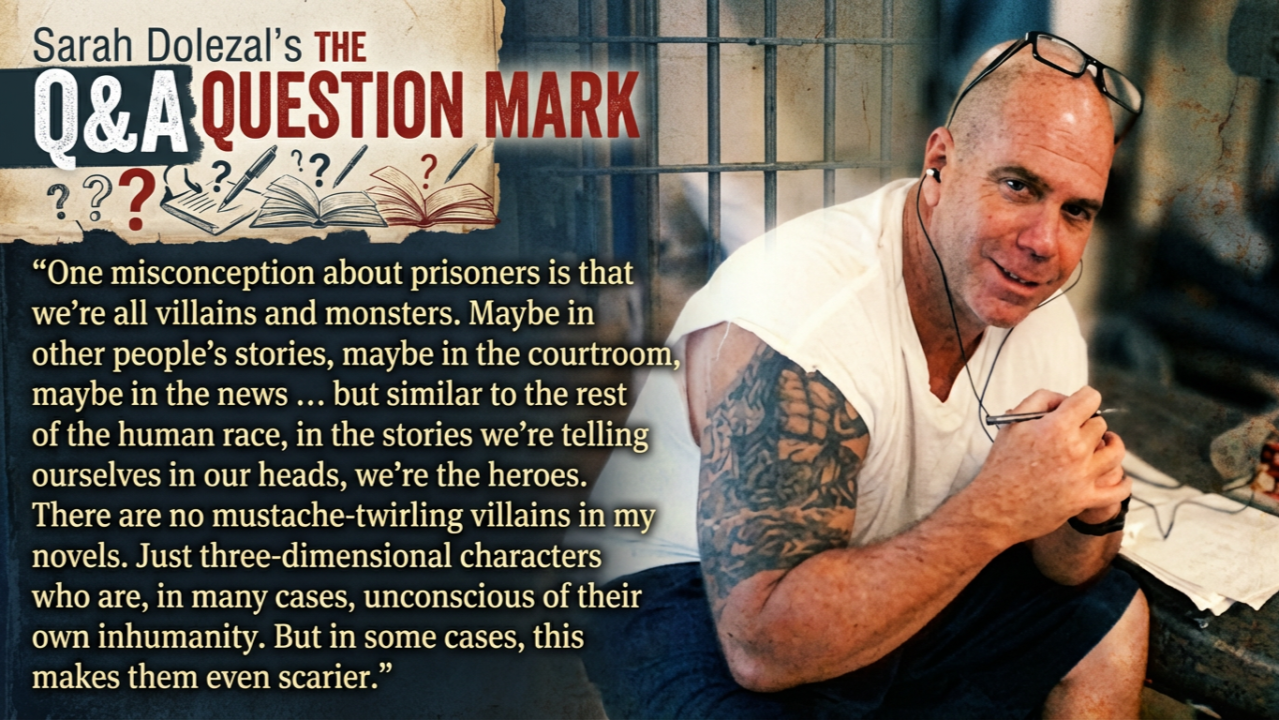
Just did this interview with freelance journalist Sarah Dolezal in The Question Mark: Expert Q&A. Momentum!
Just did this interview with freelance journalist Sarah Dolezal in The Question Mark: Expert Q&A. Momentum!

Bureaucracy. What comes to mind when you see these eleven letters? It’s strange how certain words are claimed by political movements. Imagine Biden claiming the investigation into his son, Hunter, and the infamous laptop a “witch-hunt,” or Hillary Clinton referring to her internet server scandal back in 2016 as a “hoax.” The thought of a Democrat using this MAGA vernacular is almost as jarring as the thought of Trump calling Mar-a-Lago his “safe space” or signing his executive orders “he/him.”
I know all about bureaucracies. I am currently living in one: the Federal Bureau of Prisons. (And if right now you’re imagining me riding around in golf carts while getting stock tips from former investment bankers, think again. I live in a crumbling dungeon that was built during the Great Depression. I can stick my arms out and touch both walls of my tiny cell. The water is murky, there’s black mold in the showers, and the air tastes like asbestos. But that’s another essay . . .)
After the inauguration, when Elon Musk and his merry band of tech nerds rode deep into the heart of government bureaucracy, the media outlets on the left portrayed them as a bunch of 20-year-old, nose-ringed, purple-haired college kids who, best case scenario, were threats to national security. Worst case scenario: they were hellbent on destroying longstanding programs like Medicare and Social Security. Of course, conservative talk radio and Fox News hosts labeled this as typical lib hysteria, overlooked the occasional error made by the DOGE team—like adding an extra zero to the amount saved—and cheered on the chainsaw-wielding Musk as he slashed and burned his way through USAID, the Center for Disease Control, and various other American institutions.
As my fellow prisoners and I await the great and terrible artificial eye of DOGE to train its laser-focused pupil on the 8-billion-dollar budget of the Federal Bureau of Prisons, there are two conflicting camps of expectation.
Ironically, it’s the Fox News MAGA majority who are abuzz with boundless optimism. They believe that Elon will drastically reduce the budget by shutting down prisons and allowing anyone with less than three years remaining on their sentence to finish up on home detention. And since Trump signed significant criminal justice reform into law in 2018 with the First Step Act and then pardoned 1600 Jan-Sixers on his first day back in office, there is plenty of cause for hope.
Across the unit, at the CNN television, my liberal brothers have a much gloomier outlook. They fear that less money will result in less guards which will result in less programs and inevitably more lockdowns. They take Trump’s tough-on-crime campaign promises at face value and worry that, even as American citizens, they too could end up in an El Salvadorian supermax due to federal prison overcrowding.
Where do I stand? I’ll give you one guess and two hints. (It’s neither left nor right.) If Mr. Musk begins hacking away at the FBOP, prisons will absolutely be shut down. Will this translate into people going home, or will they simply be transferred to other facilities? Hard to say. But it’s important to point out that prison profiteers like the GEO Group were key donors to the Trump war chest in 2016, 2020, and 2024. And I’m guessing that they would love nothing more than a fat federal contract to take over the Bureau of Prisons. But what would it say about this country if the same corporations who were lobbying Congress for tougher laws and longer sentences—not in the interest of justice, but in the interest of their own bottom lines—were the same companies who were receiving multi-billion-dollar contracts to warehouse the nation’s prisoners?
In many ways, it feels like America is not entering a “golden age” as the president proclaimed at his inauguration, but something more akin to the Dark Ages. Especially when it comes to the hidden world of corrections.
—April 14, 2025
Bad news, my friends. Many of you might recall me exuberantly declaring that I would be at a federal halfway house by November of this year. It’s a date we’ve had circled since I first arrived. (In 2007, George W. Bush signed a law that allowed for inmates to serve up to 10% of their sentences in halfway houses/home detention. My actual release date on a 288-month sentence is November 2026. March was my 20-year anniversary of incarceration. I am well over 90% done with this long journey.) Even though the halfway house is not really “home”; I’d be able to work a job for my final year, save money, spend weekends at Mom’s house, and make a smooth transition back into society.
Unfortunately, this will not be happening.
Due to “budget constraints” in the federal B.O.P. (the Bureau of Prisons), myself and thousands of others recently had our halfway house time severely slashed from 365 days down to just the final 60 days of our sentences. Barely enough time to find a job, find housing, and navigate a world that did not even have smart phones when many of us left. I’m lucky to have a strong support system and a place to go. Some of these guys will be starting from scratch. In an inflationary America with little or no work experience, the temptation to return to crime for a quick buck and a little stability will be difficult for some of these men to resist.
Is this good for society? Ninety percent of federal prisoners are returning to their communities one day. Is dropping them off with little or no transition period going to solve the problem of rampant crime? Is this a smart way to combat recidivism? Is this in the interest of public safety? Not by my calculus.
Again, the B.O.P. cites budget constraints as the reason for this head scratcher of a policy change. They use “limited resources, chronic understaffing, and deteriorating facilities” as their justification to reduce the halfway house time to 60 days. (Believe me, I know all about deteriorating facilities. I am currently housed in a mold-ridden, roach-infested prison that was built in the 1930s. This place should have been condemned a couple decades ago.) But is not allowing tens of thousands of people to go to halfway houses and home detention going to “ease” overcrowding? These same dilapidated, understaffed prisons are going to be more packed, more dangerous, and more expensive to run with a year’s worth of inmates who would have been in the halfway houses now needing to be fed, clothed, housed, and supervised.
The crazy thing is that it costs MORE to keep us here for longer. Prisons have overhead expenses that do not apply to halfway houses. And definitely not to home detention.
So to recap: This recent change lowers the offender’s chance for success by limiting the window of opportunity to transition and thereby increasing the chances of recidivism. It also increases overcrowding, makes institutions less safe, puts a greater strain on the workforce . . . And it costs more. A commonsense solution would be instead to immediately release all the Second Chance Act-eligible inmates to halfway houses and/or home detention for those with a verified address. But they won’t. Why? It makes too much sense. This is the B.O.P.—Backwards On Purpose.
—April 3, 2025
*** An update! I received some exciting news after I typed this essay. Three days after the BOP updated the policy that reduced my halfway house time down to a basically nothing―a few weeks―they rescinded the order! So now I am back to the very real possibility of being home for Thanksgiving. (Is it me or are we living in the era of thrilling highs an crushing lows? Just when I thought last week’s stock market ride was about as dizzying as things could get…)

One desperate afternoon in 2005, a skinny and addicted version of myself was scanning the lawn care equipment and power tools in mom’s garage for something I could pawn for dope money when suddenly I was struck by a bolt of inspiration: Why deprive mom of her weed whacker when I can easily rob a neighbor? There was far more honor in that, right? I went in through the bathroom window.
First thing I found was a loaded 9mm. Fate crackled in the barrel. I tucked it into the waist of my jeans then made a quick check for jewelry and money before slinking off into the March afternoon to do what the broken people do. (Legal note—Since I armed myself in the commission of a crime, this simple burglary became an armed burglary. A first-degree felony punishable by life in prison.)
Over the next 36 hours in a dope-fueled tailspin, I used this weapon to jack various area drug dealers as well as two convenience stores. In the parlance of Narcotics Anonymous, this phenomenon is referred to as “a case of the fuck its.” Luckily no one was harmed in my unraveling. I never even fired the gun. And because I spared the State the expense of a jury trial, the State spared me the misery of a life sentence. (Legal note—According to Florida’s 10-20-Life law, brandishing a firearm in the commission of a felony carries a mandatory ten years, firing the weapon carries twenty, shooting someone triggers a life sentence. There is no parole.)
I ended up with twenty years in the department of corrections along with more than a quarter century in the federal system. For a more detailed account of the night of my arrest, check out the Divine Intervention essay at malcolmivey.com. But please do not mistake my tone as flippant or unremorseful. This could not be further from the truth. I am deeply humiliated by the weak and pathetic actions of that miserable little crackhead. It’s just that all this occurred almost two decades ago and when you spend so many years pacing cells, alone in your head, relentlessly scrutinizing your life and the moment things went south, over and over and over again, it all becomes a little mechanical. Like a movie you’ve seen a million times. Groundhog Day.
I am a gun criminal. Embarrassing to admit this with all the recent ugliness on the evening news, but my record speaks for itself. No getting around it. I was actually classified as an Armed Career Criminal by the United States government until a 2016 Supreme Court ruling resulted in my federal sentence being overturned.
Although the above debacle was my first taste of armed robbery, it was not my first rodeo. I’ve been sleeping on hard institutional bunks and eating cold food on dirty trays since I was a pre-teen in juvenile detention. I don’t pretend to know a lot about the outside world because I’ve been removed from it for so many years, but if there’s one subject I’m fluent in, it’s the criminal justice system. I’ve written six books and over 100 essays on life behind the razor wire.
With this recent spike of violent crime—not just the tragic and headline-dominating mass shootings but also gangland drive-bys, ambushed police, and robbery homicides—many old guard politicians are already dusting off their tough-on-crime speeches from the ‘90s. And the public will predictably respond at the polls. For good reason: something has to be done. But I would argue that the solution will not be found in tougher laws. How much tougher can you get than consecutive life-without-parole sentences? The death penalty? We’ve got that too. And the robberies and car-jackings and murders continue to surge. Einstein famously said that the definition of insanity is doing the same thing over and over and expecting different results. Another approach might save us from where we are headed.
All across this great nation, impoverished young people with mothers and fathers either in early graves or serving lengthy prison sentences are walking the same lonely roads as their parents. Why would anyone choose such a miserable existence? Maybe it’s not a choice. I know they’re not getting much help from their countrymen. Especially not our nation’s two political parties. The liberal message which blames systemic racism for every bad break and poor decision provides zero viable solutions and runs counter to American ideals of self-sufficiency and accountability. The conservative pull yourself up by the bootstraps narrative is unrealistic as well. When you’ve never met your incarcerated father and your mother alternates between violent dopesickness and being slumped on the couch, when your world is confined to the project buildings and trailer parks where you were born, when most of your neighbors supplement their government assistance income with some form of hustling, when your normal consists of scrapping and stealing just to survive, when this is all you’ve ever known, you don’t just wake up one day, crack your knuckles, and decide to go to vocational school. It may happen occasionally. But as the exception, never the rule. So what? you’re probably thinking. Why should the average American care? Why should you care? I mean, we’re talking about a bunch of criminals and slum dwellers, right?
Well…
If Covid has taught us anything, it’s how interconnected we all are. Conspiracy theories aside, a virus from Wuhan China has circled the globe and killed millions of people. An incident in a laboratory on the other side of the world has wreaked that much havoc. And we’re still dealing with the aftermath—supply chain issues, factory shutdowns, inflation, mutations, political unrest. The shockwaves are inescapable. Even the remote Panhandle prison where I sit and type this essay is not immune. Outside my cell door is a beleaguered workforce, rising canteen prices, diminishing food portions, rampant drug abuse… But our interconnectedness is not limited to global pandemics. Look how the Russian invasion of Ukraine has affected the price of fuel, and how the price of fuel has affected world markets, and how plummeting markets have affected people’s 401(k)s. Like it or not, we are all in this together.
So it follows that if events in Asia and eastern Europe can have an impact of this magnitude on Bible Belt America, then what about that other section of your very own hometown? What about fentanyl, what about meth, what about gangs, what about an ideology and culture that places no value on human life? It doesn’t take an epidemiologist to recognize that violent crime is spreading exponentially. And it is no longer confined to those neighborhoods across the tracks. A generation of unraised and unloved children are coming of age. You see their faces every night on the local news. And on their way to life sentences in prison and fatal gunshot wounds, they’re making babies who will also grow up fatherless, motherless, hopeless… America has extremely broad shoulders. But at some point she will collapse beneath the staggering weight of her broken citizens. And the world’s longest running democracy will finally come to an end. That is, unless we do something. But what can we do?
I have two suggestions.
The first is so simple that it seems inarguable. We need to love our kids. And by “our kids” I mean America’s kids. We need to teach them the value of honest work, discipline, and respect. All of them. No child among the 330,000,000 of us should grow up without a rock-solid support system, without consistent direction, without love… Imagine a coalition of teachers, athletes, business professionals, community leaders, neighbors, moms, dads, police officers, even reformed ex-prisoners committed to stepping up and assuring the abandoned and forgotten that there is love in the world. Not by throwing money at the problem or writing preachy and long-winded disquisitions like this one 🙂 but by rolling up our sleeves and investing our time and our hearts and our energy in the coming generation—and doing this with the same sense of urgency and conviction that Christian missionaries carry on their voyages to foreign continents every day. If we don’t, then the only ones who will suffer the consequences is us.
You will disagree with this second suggestion. And I totally understand. But I can only tell you the truth as I see it. And what I’ve seen every day for decades in prison is young unaffiliated men stepping off county vans, wide-eyed and green to prison life, ready to do their time and get home. Only to exit the system years later as full-fledged gang members with the requisite crowns, stars, and swastikas tattooed on their heads and necks. Why? First of all, prison is a dangerous place and there is always safety in numbers, but there is also the allure of dope, money, cell phones, respect, and brotherhood. Five years ago I wrote about this emerging crisis in a series of essays called Fixing a Broken Prison System. At the time, gang members made up about 10% of my dorm. Today it’s closer to 25%. Again, who cares about a bunch of prisoners and low-income trash, right? But these same hardened young men are returning to their neighborhoods as heroes home from war, and many are indoctrinating the young people in their communities. That’s not just a problem. That’s systemic failure.
The Florida Department of Corrections cites public safety as a top priority. This is emphasized in their mission statement, core principles, and pretty much every press release regarding prisons and prisoners. Yet on this, they are failing the public on a scale so spectacular that it boggles the mind. There’s a relatively easy fix for it, but it flies in the face of every stump speech being made by every tough-on-crime politician on the Florida Panhandle right now. Be tough on crime. Hell yeah. Be merciless on crime. But bring back parole.
Aww Malcolm… you’re just trying to get your buddies home.
This is true. And if you knew some of my friends (and their mommas) you would see why. Good people. Men who changed their lives decades ago and are now just hanging around, waiting to die. Many of the guards who work here would attest to this. But allowing men and women to earn their way home would have ripple effects far beyond my circle of friends.
Imagine a prison system where every person arriving at the reception centers—barring pedophiles and clinically diagnosed sociopaths—would be given a series of diagnostic tests to gauge IQ, reading and math levels, vocational skills, emotional intelligence, etc… Once their history and aptitude are established, a team of psychologists, educators, and trained classification officers would set a number of almost impossibly high benchmarks to be reached over time. A final meeting with the incoming offender would sound something like this: “Okay, young man, you’ve been sentenced to life in prison. Life means life in the state of Florida. This means you will die behind these fences. But that will probably be 70 or 80 years from now since you’re only 18 years old. During that time everything you love will be taken away. However… there is a faint possibility that you might be able to one day earn your way home. But only if you accomplish the following. Get your GED, get your bachelor’s degree, complete these 50 courses, log in 10,000 hours of anger management, keep a clean disciplinary record… And, by the way, if you join a gang you are automatically eliminated from the program.”
Something like that. If this idea were implemented, prisons would be safer, guards would have a legitimate management tool, and gang affiliation numbers in Florida would plummet within a decade. Amazing what a little hope can do. Of course, there will be some who try to game the system, but over time I think even those men and women would be converted. I know from my own experience that a strange thing happens on the road to education: the more learned you become, the less likely you are to do harm to your fellow man.
I mentioned all this to a teacher at the prison where I’m doing my time. Really cool guy—an Army Ranger with a bachelor’s in political science. He identifies as a fiscal conservative but leans slightly left on matters of social justice. His response: These are not kitchen table issues for the average American. People are worried about inflation, the price of gas, illegal immigration. Not the plight of inner-city kids or criminal justice reform.
He’s probably right. The human brain is not wired for distant threats. This is why things like rising sea levels, ballooning national debt, and evaporating social security are such a hard sell to so many. In his spectacular book, Focus, Daniel Goleman illustrates this phenomenon perfectly. “We are finely tuned to a rustling in the leaves that may signal a stalking tiger. But we have no perceptual apparatus that can sense the thinning of the ozone layer, nor the carcinogens in the particulates we breathe on a smoggy day…”
Ditto the long-term effects of the school-to-prison pipeline and the broken criminal justice system it feeds.
I’m guessing many of you disagree with all this. I probably would too if I hadn’t lived in here for so many years. But I can’t unsee these problems and potential solutions. Aside from writing books and enjoying the people I love, the rest of my life will be dedicated to improving this social condition. Maybe I can pay my proverbial debt to society in this way. A few years ago these concepts might have found more traction. There was an empty Supreme Court seat, bipartisan momentum for criminal justice reform, and conservative politicians like Jeff Brandes roaming the Capitol halls. That time has passed. Violent crime is soaring and hardliner rhetoric is the message of the day. The pendulum has officially swung. But popular or not, I will continue to bang this drum until someone hears me. Groundhog Day.
Memory has always been my strong suit. You want the theme song to Diff’rent Strokes, Facts of Life, or any other 80s TV show? No problem. The lyrics to “The End of The World as We Know it” by REM? Which verse? The wide receiver depth chart for any of the NFL’s 32 teams? Coming right up. Yet lately I’ve been having these little moments. Times when my prefrontal cortex is unable to scroll or double-click. Times when I can’t remember shit. Let’s call them glitches.
I keep thinking… maybe it’s some sort of mid-forties brain recalibration thing, or because I’ve had a massive head injury, or the residual effect of squandered gray matter from years of drug use. Maybe. But the more I read up on the pandemic, the more I wonder if it’s something else entirely.
I know I’ve had Covid. Half my dorm was waylaid back in October, the third time we were quarantined. A friend of mine ended up going to an outside hospital for a month and when he returned to the prison, he died within a week. The official line was that he recovered from the virus but couldn’t survive the ensuing pneumonia. That’s why it wasn’t ruled a Covid death on the institutional scorecard. If that sounds sketchy to you, join the club.
No Covid tests were conducted on the other 70 men in my dorm. Just daily temp checks. Not that we wanted them. Quarantines are a massive inconvenience in prison. More punishment than precaution. No rec, no canteen, no movement (which translates to no hustling). Just a biohazard sticker on the door for fourteen days. They do nothing, solve nothing, protect no one. As long as guards are coming in everyday for shiftwork, the virus will circulate. No getting around it. Not in open bay dorms where there’s 12 inches between your feet and your neighbor’s head. It’s gotten to the point that no one reports symptoms. When you have a life sentence, global pandemics mean about as much as presidential elections.
But the way we knew something was up — aside from feeling like hell — was that no one could taste or smell anything. You know those cologne advertisements in men’s magazines like Esquire and GQ? My friends and I would wave strips under each other’s noses. Nothing. It’s a strange experience to breathe deeply through the nostrils and not register a scintilla of scent. Especially in a prison dorm where pungent smells are abundant.
But even stranger are the memory lapses. At least in my experience. Neuroscientists are just now starting to understand the effects of Covid on the brain. I recently read an article by Dr. Sanjay Gupta about some of the devastating long-term and short-term neurological complications of the virus including delirium, depression, temporary brain dysfunction, headaches, brain inflammation, and meningitis. He cites a report in the journal Nature that details the symptoms of a woman in her fifties who saw lions and monkeys in her house and accused her husband of being an imposter.
I guess my forgetting the lyrics to “Come On Eileen” pales in comparison to zoological hallucinations, but it’s still cause for alarm in my little corner of the multiverse. What if this is the beginning of a tumble into the abyss? I researched enough about dementia while writing Sticks & Stones to understand what a terrifying prospect it is.
Covid or no Covid, my defense against cognitive decline remains unchanged: exercise daily, meditate for ten minutes, learn new things, do plenty of crosswords, and write with my hair on fire. (Yeah, I’m bald. 5 books. Where do you think it went?)
As Leonard Pitts once so eloquently put it, “Without memories what are we? We are the equation after the blackboard has been wiped clean.”
This time last year a little old man moved into the bunk at the end of my row. Amphetamine thin with no teeth and two faded teardrops tatted under his right eye, barely visible in the wrinkled roadmap of his face. It was obvious from day one that he was a character.
“Where you from, pops?”
“Pasco.”
“Oh yeah, I know a few people from down there. Where at in Pasco County?”
“Pickatree Lane… I just pick me a tree and go to sleep under it.”
Donny has been homeless for most of his adult life. This is his seventh time in prison. He’s been in and out for the last fifty years, doing life on the installment plan. Because he fits the profile, many of my fellow inmates assume he’s a pedophile. He’s not. He’s one of us. He just got old.
Although he’s not really all that old. Seventy. There are men his age doing pull ups on the yard. But Donny’s seventy is a hard seventy. His pull-up days are long gone. He can barely get off his bunk without help, he pees on himself in his sleep, his hands shake, he’s damn near blind, and his brain is clouded with dementia. But you wouldn’t know that from all the smack he talks.
“Hey George. Does your mother know you’re a damned queer?”
“My mother died last year.”
“Yeah, mine too. Get over it.”
There is not a politically correct bone in the old man’s body. He drops n-bombs without a second thought, mocks my Latino friends by talking gibberish, and openly ogles every female guard on the compound. Some would say Donny’s filter is broken, but I’m not convinced he ever had one. He’s just a relic from the rural south who’s spent most of his life in a cage. Or sleeping on sidewalks.
I had just received a job change from impaired assistant to administrative clerk when he moved into my dorm. I was writing a novel, the first in a series, about a young woman who takes the fall for her dope dealer boyfriend, finds herself in prison, learns her way around the law library, and discovers that she’s a natural in the process. But I knew I couldn’t write convincingly about something as complex as the law without learning it myself. So I got a job in the prison library for research purposes.
I kept seeing Donny shuffle by the window every morning for legal mail. He wasn’t difficult to spot. He’s got one of those Rollator things; sorta like a walker with wheels. One day he banged on the library door demanding assistance. I explained to my free-world boss that he lived in my dorm, had a touch of dementia and was in really poor health.
He entered the library shivering. “Damn it’s cold out there!” (It was maybe 75 degrees. Early October Florida Panhandle weather.) He looked at me. “I need your help, young feller.” He pronounced help like “hep.” When I asked what I could do for him, he slapped a letter on the counter. It was from an attorney representing GEICO.
Between the letter and a maddening hour of circular and sometimes nonsensical discussion with him, the details emerged. He was hit and dragged by a car before he came to prison and the insurance company was offering $50,000 dollars. Problem was, the hospital had placed a lien on him for the weeks he spent recovering. After checking with a couple of the inmate law clerks, it became clear that his chances of ever seeing the money were slim. Even if the hospital mercifully forgave the lien, the Florida Department of Corrections would come after him for all the free room and board. Either way, the consensus was that he would never get a dime. An exclamation point to a lifetime of bad luck.
I wrote the hospital for him anyway. Just to do something. They never responded. I’m not even sure if the letter reached its destination. I’m not even sure I wrote the right hospital. But just after Christmas, fifty grand was deposited into his inmate account. And my status was sealed in his eyes.
Months passed. I was caught up in the world of my characters. He was caught up in his new-found wealth. Occasionally I would look up and see him smashing a honeybun or a nutty bar. Once in a while I would walk into the bathroom and be confronted by a horrific scene involving him, feces, and bad aim. I knew that the guy caring for him was more interested in enjoying Donny’s canteen food than making sure he was okay. But at least he changed his sheets, cleaned up his messes, and walked him to chow. I rationalized what I saw by telling myself that it was a mutually beneficial relationship. Dude was doing something that nobody else wanted to do.
Because Donny saw me as advocate and ally, he would sometimes hobble over to my bunk and say things like “I want to go to the infirmary.” Why man? What’s up? Are you sick? “Naw. I just don’t like it in here…” Well hang in there. You’ve only got 18 months left. “Damn, that’s a long time!” He was always surprised when I told him his release date. He could never remember. It wouldn’t have mattered anyway. He had no idea what year it was. I pacified him by telling him I’d write the warden requesting a transfer to his hometown of Zephyr Hills. But I never got around to it.
Then Covid hit and the library closed. I was in the dorm for six extra hours a day. Suddenly all the things I conveniently ignored were constantly in my face. Donny weighed less than 150 when he got off the bus. Skin and bones. Now he was easily 250 from pounding sweets all day. Itchy red sores littered the landscape of his body. His feet were swollen and purple. His area reeked of urine. His pendulum swung from listless mumbling to angry ranting with fewer moments of clarity in between. The medical department was indifferent. The guards saw but didn’t see. And all his caretaker seemed to care about was eating his canteen food. My conscience grew louder. He needed me. But how could I let the other guy know that his services were no longer required? Especially since relieving him of his duties meant taking food out of his mouth.
In the end, the Universe intervened. A corona outbreak in the kitchen dorm prompted the need for 100 new food service employees. Shady caretaker guy was one of the lucky lottery picks. So he packed his shit (and probably half of Donny’s) and moved to another building. A few days later, someone in my dorm tested positive and we were placed on quarantine. During those 14 days, the old man must’ve peed in his bed 21 times. I’ll spare you the details of some of our other adventures but believe me when I say it was not your typical male bonding experience.
That was three months ago. Today, I’m proud to report that my good friend Pickatree is back to his old gruff, womanizing, politically incorrect self. A steady diet of oatmeal, tuna, eggs, peanut butter, trips to the rec yard, regularly scheduled bathroom visits, and basic human kindness have made all the difference. Sometimes I worry about what’ll become of him when he gets out, but I try to stay focused on the things I can control. My mission is to get him to the door. The rest is in God’s hands.
“Donny. You’re worth 50 grand! What’s the first thing you’re gonna buy when you get out?”
“Ice cold Busch beer. When do I get out again?”
“Right around fifteen months.”
“Damn.” He shakes his head. “That’s a long time.”
Most of my family and friends are into Making America Great Again… again. They are not racists. They are good people, religious people, Catholics and Evangelicals who believe that abortion is the most important item on the docket when electing a president. So four years ago, many of them held their noses and voted for a philanderer and a bully and a race baiter because there was a Supreme Court seat open and the big prize of Roe v. Wade was dangling over the plate like a 35 mph fastball.
By the looks of it, they hit a towering home run. In fact the ball is still blasting through the stratosphere.
When Justice Scalia died in early 2016 and the Senate refused to even have a hearing on Obama’s nominee to replace him until after the election, they effectively put a Supreme Court seat on the ballot. A stroke of brilliance, really. But never in conservatives’ wettest dreams did they imagine that two more seats would come open in the ensuing 48 months. A 6-3 conservative majority on the highest court in the land would almost certainly be enough to overturn the landmark abortion case. At least that’s the hope. Or the fear, depending which side you’re on.
I’m not sure where I stand on abortion. Is that all right? To be undecided? To be conflicted about such a polarizing issue? If we’re committed to putting science first on the crucial issues of Covid and the environment, why not listen to what scientists have to say about abortion? Especially late-term abortions. I’m guessing we know a lot more about the human embryo in 2020 than we did 50 years ago, just as we know a lot more about melting ice caps, carbon emissions, and the ozone layer. But I have the luxury of being an armchair quarterback on this issue since I am a man and will never have to make that difficult choice.
Abortion is not my main focus during election season anyway. Neither is the environment nor the Second Amendment nor the economy nor health care. When I’m gauging a candidate, it’s all about prisoners and the families of prisoners. And since presidents appoint not only Supreme Court Justices but lower appeals court judges, these elections have a direct impact and far reaching consequences for my little demographic. (And by little I mean the 25% of the world’s incarcerated who reside right here in the U.S.)
Contrary to popular belief, and despite what they may say in confirmation hearings, these judges are not fair and impartial callers of balls and strikes. That era is long gone. In the 70s, under liberal justices Thurgood Marshall and William Brennan, the Court declared capital punishment unconstitutional, supported Roe v. Wade, and upheld affirmative action. But under Nixon appointee William Rehnquist, whom Reagan made Chief Justice in the 80s, the death penalty was brought back, prisoners’ rights were reduced, and the court ruled that education was not a fundamental right in America. Occasionally some Justice will drift to the center in his or her old age but that’s happening less and less these days. Most judges are now groomed from high school for these lifetime positions and thoroughly vetted before they make the short list. Too much is at stake.
That’s why the idea of a devout conservative like Amy Coney Barrett supplanting a liberal paragon like Justice Ginsburg is so painful. She will be on the court for possibly the next 40 years. This feels like Clarence Thomas being tapped to replace Thurgood Marshall all over again. That was 30 years ago and he’s still the most conservative Justice on the bench.
But the irony in all of this isn’t that Republicans are rushing to ram through Justice Ginsburg’s replacement 30 days before the election, even though they refused to hold a hearing on Obama’s appointee with eight months left. Or that all this is going on despite RBG’s dying wish that they wait until America goes to the polls. Or that the court is moving back into the 1950s while the rest of the nation is moving in an entirely different direction… The irony is that the least intelligent and most polarizing president in the history of the Oval Office, number 45 out of 45, will have replaced a third of the Supreme Court during his rocky four-year tenure. And if he declares this election rigged, refuses to accept the results, and there turns out to be a court battle, guess who will be casting the deciding vote.
 They passed out masks at my prison last week. Triple-ply polyester squares made from uniform pants that are mandatory when we’re not eating, sleeping, or bathing. As if the barren, windswept Times Square footage on the evening news was not eerie enough, or the daily death toll on the GMA news ticker, or the images of shiny, late-model SUVs in five-mile-long food queues… Prison life just went from dark to dystopian in the elastic snap of a mask.
Although I’m convinced that a third of my dorm already had the virus back in February (myself included), the pandemic has not officially reached the prison where I am housed. Not since authorities began keeping track, at least. But it has ravaged two of my previous camps. Sumter Correctional had one of the biggest outbreaks in the state, and Blackwater Correctional has had four deaths with hundreds under medical quarantine. I have so many friends trapped in those places. We’ve grown up together in the prison system. Their families and my family brave the weather and the rudeness and the indignity on the weekends in order to spend a few hours with their sons and husbands and brothers. Or they did until visitation was canceled almost two months ago.
I’ve been hesitant to write about the corona virus. In this era of daily televised White House briefings, where Dr. Fauci is a household name and the president is faced with an enemy he can’t dismiss as fake news or a witch hunt, where the NBA playoffs have been canceled and the NFL draft is held online, where everyone is talking about hot spots and flattening curves and social distancing, what can I possibly add to the conversation? I’d rather talk about books and music and football.
But these essays are more than social commentary. They are chronicles. Mile markers. One day I will read over them as a free man and remember where I was when each was written. What was going on. And as much as I want 2020 to be known as the year Tua took his talents to South Beach, the year Brady became a Buc, the year I finally finished writing this novel… all these will be footnotes in the annals of history. 2020 will forever be known as the year of the pandemic. The year when everything changed. The year the handshake died, the mall breathed its last gasp, and the world was reminded of just how interconnected we all are. Rich and poor, black and white, American and Chinese, convict and guard, conservative and liberal. If we learn nothing else during these troubled times, hopefully it will be to put data and science before politics, to say “I love you” while we have the shot, and to take better care of our grandmothers and grandfathers. There is no them… only us.
Stay safe out there.
There is zero political correctness in captivity. No one tiptoes around emotions or tries to figure out ways to put things delicately. Contemporary millennial vernacular with its “triggers” and “safe spaces” is a language alien to the chain gang. Here, racial slurs are commonplace, women are bitches and hoes, and even the LGBTQ community doesn’t bother saying LGBTQ. They just call themselves sissies and punks like everyone else.
It is through the blunt prism of this parallel universe that I first noticed presidential hopeful Mayor Pete Buttigieg. Noticed and immediately dismissed him based on the fact that he’s gay. How could I do such a thing? The same way most people do ignorant things: I did it unconsciously. I live in a world where homosexuals rank somewhere around child molesters and snitches in the food chain. No way a sissy could lock horns with Donald Trump. Much less strongmen world leaders like Putin, Kim Jong-un, or Duterte. No way America would elect a gay dude to the White House.
Then I heard him on the debate stage. Several times. And I watched him on the Sunday morning roundtable shows. The more I listen to him speak, the more difficult it is to dismiss him based on who he loves. What business is it of mine anyway? He’s not auditioning for The Bachelor, he’s running for president. It’s his vision and character that matter.
Mayor Pete is an Afghan War vet, Naval intelligence, Rhodes scholar who speaks seven languages. At age 37, he’s the youngest candidate in the field which means, more than any other candidate, he has a stake in things like climate change and the national debt because he’ll still be around when these fiscal time bombs are set to go off. He describes addiction as “a medical problem, not a moral failure,” seeks to end prison profiteering, and abolish minimum mandatory sentencing. He thinks we should measure our economy not by the Dow Jones but by the income of the 90%. He’s moderate in his politics. He’s not out there trumpeting “free everything for everyone and Jeff Bezos is gonna pay for it!” Any far-left president as a knee-jerk response to four years of Trump’s America First/Pat Robertson brand of isolationism would only pave the way for another wild overcorrection in 2024. Too much is at stake for that. We need a uniter. Someone who will galvanize and energize, not polarize. But make no mistake, Mayor Pete would eviscerate Donald Trump on the debate stage. Run circles around him.
And yet.
There’s still this lingering voice in my head. “Come on, man. Really? There’s no way . . .” I keep thinking of the Conservative Christian wing of my friends and family. Good people who held their noses and voted for Trump not because they’re closet racists or because they believed that Hillary was running a sex ring out of the back of a D.C. pizza shop, but out of concern for the unborn. They believed they were doing the right thing. The Christian thing. How could those people of faith ever reconcile their spiritual walk with voting for a gay president? I don’t know. Seems like the Sermon on the Mount would supersede an obscure line in Romans, but I’m the wrong guy to argue Scripture. Ultimately, I think that anyone who would hold this against him at the ballot box is probably already voting for Trump anyway.
I don’t have a say in the matter. Other than these words. I forfeited my right to participate in our democratic experiment in 2005 when I was arrested for armed robbery. Humiliating but true. But if I did have a vote, I’d be casting it for Mayor Pete. I think he’ll make a terrific president.
—February 2020
 Malcolm Ivey / Author