Skip to content

20 Years of Memoir

“This is not a memoir. Memoirs are for chicks…”

I remember exactly where I was when I scribbled these words into my notebook, the first words of my third novel, On the Shoulders of Giants. It was early 2015 and I was at Blackwater River Correctional facility, commonly referred to as “Sweetwater” by the inmate population back then. Memoirs are for chicks. Not sure why I began the story of Izzy and Pharaoh and Scarlett this way. Probably because I was reading Eat Pray Love at the time, the quintessential chick book.

Sweetwater is nowhere near as sweet these days. I just had a buddy there get his face slashed from orbital bone to the corner of his mouth. A quiet, non-gang-affiliated, middle-aged black dude who minds his own business and respects everyone. They permanently disfigured this guy so they could take their time emptying the few soups he had in his locker while he was getting medical attention. Pathetic.

But I’m getting sidetracked here. I guess being so near the end of this long prison sentence has got me looking back. The point of this was to share the 10 best memoirs I’ve read over the last 20 years. So here we go…

  • Eat Pray Love by Elizabeth Gilbert—Loaded with wisdom, humor, and spectacular writing. I know this book by heart. Even though it’s been a decade since I last read it, I can still vividly remember multiple passages: the soccer game, the paragraph on the word “harbor,” her description of the meditative experience… But her riff on the Oak and the Acorn was so profoundly instrumental in my own development that I quoted it in my own little hybrid memoir. Twice.
  • Corrections in Ink by Keri Blakinger—Possibly the best memoir I’ve ever read. Especially on the subjects of addiction and incarceration. Ms. Blakinger is fluent in both the Ivey league and the underworld, and her storytelling style is equal parts gritty and poetic. The world is fortunate that she tamed her demons and shook off her chains in time to tell this story.
  • The Audacity of Hope by Barack Obama—I’ve read this one a couple times too. The former President wrote this well before his historic run to the White House in 2008. Although he has been dismissed as a “far left progressive” by those who would view him as the enemy no matter what he believed or wrote, this book is a meditation on pragmatism and moderation and working together. And a masterclass on how we arrived at this point in our nation’s history by a constitutional law scholar.
  • Whip Smart by Melissa Febos—I wrote an essay about Ms. Febos that is included in my own hybrid memoir, Letters to the Universe, called “Back to Work.” It focuses on a couple letters we exchanged when I was in solitary confinement in 2016. This book is her first, a memoir on the time she spent working as a dominatrix in a Manhattan dungeon.
  • Bird by Bird by Anne Lamott—A must for aspiring writers. One of the best books on the craft ever written.
  • The Glass Castle by Jeannette Walls—And I thought my family was dysfunctional. I have sent this book to many of my incarcerated female friends at Lowell. This is one of my favorite books of all time, irrespective of genre. I’ve never seen the movie, but I know Woody Harrelson played the father.
  • On Writing by Stephen King—I came across many of my other favorite books by combing through his reading lists in the back. (The Poisonwood Bible by Barbara Kingsolver, Life of Pi by Yann Martel, The Brief and Wondrous Life of Oscar Wao by Junot Diaz.) Stephen King is a national treasure.
  • Wild by Cheryl Strayed—There is quote in this book that is foundational for me: “Life is the story that we tell ourselves in our heads…”
  • The Dirt by Motley Crue—I wasn’t really a fan of the band or their music when I picked this up. I mean, I was familiar with “Home Sweet Home” and “Wild Side” and “Don’t Go Away Mad (Just Go Away)”. After all, I am a child of the ’80s. But this book, with its bottle of Jack on the cover, is compulsively readable. Maybe the best rock memoir of all time.
  • We’re All Doing Time by Bo Lozoff—A book that changed my life. It is still free to prisoners from the Human Kindness Foundation. Bo and his wife Sita spent decades visiting death row and maximum-security units teaching men and women meditation and yoga. If you’ve ever read Consider the Dragonfly, you’ll remember it as the book that Smoke left CJ.

20 Years of Fiction

In a couple months I’ll hit a major milestone in my prison odyssey, the 20-year mark. That world out there has changed so much over the last two decades. I remember sitting in my cell, watching the news as Hurricane Katrina decimated New Orleans in 2005, thinking how I was just buying crack in a 9th Ward housing project a couple months before. If someone would’ve run up to me back then and said “Dude! There’s a hurricane coming!” my response would’ve been something like “And???” It’s crazy to call myself lucky after wasting so much of my life in prison, but I consider myself a very lucky man. Fortunate to have survived my own ignorance. Blessed to have transcended my old knucklehead self. Grateful to have a release date.

There is such a thing as criminal menopause. Most 50-year-old prisoners neither think nor act anything like the younger, more impulsive versions of ourselves. Years in isolation will do that to a man.

One misconception of institutional life is that it is nonstop danger and violence. Pure adrenaline. This has not been my experience. There are patches of turbulence, for sure. But for the most part, prison life is monotonous. This is why so many of us turn to books. As a character in my favorite David Mitchell novel once pointed out, “Though books are no true escape, they will keep a mind from scratching itself raw.”

The following is a collection of books that have kept me company over these last 20 years of incarceration. Not just any old books.  Masterworks. I selected ten in no particular order. Just the best of the best.

  • Cloud Atlas by David Mitchell—I almost gave up in part one. What a colossal mistake that would have been. This is one of those books I return to every few years. Gas.
  • Cloud Cuckoo Land by Anthony Doerr—I read his Pulitzer Prize-winning All the light We Cannot See first. Terrific novel. But this one is even better.
  • The Goldfinch by Donna Tartt—Not sure why I even picked this one up. But once I did, I could not put it down. Such memorable characters. Awesome book.
  • The Kingkiller Chronicle by Patrick Rothfuss—I keep hearing unconfirmed rumors that number three in this masterful series is finally out. I’m not a fantasy reader, but the story of Kvothe transcends genre.
  • I Know This Much is True by Wally Lamb—A novel about twins and schizophrenia. My friend Greg recommended this to me in B dorm at Okaloosa in 2017. I was on bunk check from the first page to the last. Instant classic.
  • A Song of Ice and Fire by George R.R. Martin—Someone forced Game of Thrones on me at Century Correctional in 2007. I read the first couple pages and thought “Nah.” Again, I’m not a fantasy guy. But then we went on lockdown for a stabbing, and I was stuck in my cell with no one to keep me company but Bran and Arya and Jon Stark and the Lannisters. For the next 10 years, I was back and forth between the Florida Panhandle and Westeros.
  • The Nix by Nathan Hill—Brilliant writing. I’ve been thinking about this one a lot lately with the DNC convention coming up in Chicago. He nails the ’68 riots. But this is a love story at heart.
  • Gone Girl by Gillian Flynn—One of the greatest twists in modern fiction… I heard they made a movie out of it, but I’d be willing to bet that no director could do on the screen what Ms. Flynn does on the page.
  • The Mars Room by Rachel Kushner—I read this around the time I started writing the Miranda Rights series. The author illustrates the incarcerated mother’s regret and pain as if she herself was serving a life sentence.
  • Infinite Jest by David Foster Wallace—A 1,000-page novel with hundreds of footnotes that require a separate bookmark. In the movie about this author, who sadly committed suicide a little over 15 years ago, he said that when the mailman dropped the advance copy on his porch it sounded like a bomb going off. Some of the most hilarious and tragic and brilliant writing I’ve ever come across. A difficult but highly rewarding read.

Anything is Possible

Dateline: Washington, D.C., Inauguration Day 2021.

As President Joe Biden looks out over the empty windswept National Mall and into the living rooms of 325 million Americans, pumping a message of healing and unity, the odds of his success—of America’s success—could not be longer.

Rahm Emanuel recently framed it like this: “Lincoln had the Civil War, Wilson had the pandemic, Roosevelt had the Depression, and LBJ had the civic unrest of the 1960s . . . Biden has all four.”

Sobering thought. And this is not even factoring in the bridge-mending that will have to be done with our allies, addressing our crumbling infrastructure, reigniting faith in our cratering institutions, negating the inroads that Putin and the Russians have made into our election system, improving health care, solving immigration, passing criminal justice reform, managing the opioid crisis . . .

And he must do it while navigating the smoke and noise of a sensationalist, hyperventilating media, as well as the conspiracy theorists, the Trump loyalists, the extreme wing of his own Democratic party, and the binary reality of modern American politics where one side needs the other to fail.

This will no doubt be an extremely tough task.

But he wanted it. He earned it. Fought through the field in a packed primary, survived one particularly brutal debate, an election night that dragged on for days, an iconoclastic incumbent who refused to accept defeat, and an attempted insurrection, all to arrive at this moment in history. Now here he is. Here we are. The question is: where are we going?

One of the many frustrating themes of the outgoing Trump regime was its disdain for the truth. They coined the phrase “alternative facts” from the jump, and it would become a cornerstone of the administration for the duration. In order for us to find our way out of the wilderness, the truth needs to be magnetic north on our national compass.

Here are some hard truths that President Biden and congressional members of both parties must come to terms with over these next pivotal years:

— Racism is a massive problem in this country, but no ethnicity has a monopoly on it. Double standards have become increasingly glaring in recent years and hate groups are using these as tools to recruit and indoctrinate America’s alienated youth. If we continue down this road of highlighting the skin color of bad cops and unarmed victims only when it suits a certain narrative, we’ll never disentangle ourselves from the baggage of our ancestors. We are Americans first. Black, white, brown, red, yellow, blue, whatever. Our histories and destinies are all entwined. And whenever any American kills another American, it’s a sad day for us as a people.

— Compromise needs to make a comeback. Special interest groups like Planned Parenthood and the NRA view any concession (the banning of third-trimester abortions, the banning of automatic assault rifles) as a slippery slope toward their own extinction. They use their money and influence to strong-arm senators into never giving an inch. This is no way to govern. The ability to work with those across the aisle is an asset, not a liability. We should demand it from our representatives.

— American isolationism is bad for us and bad for the world. Biden’s former boss said it best: “If moral claims are insufficient for us to act as a continent implodes, there are certainly instrumental reasons why the U.S. and its allies should care about failed states that don’t control their territories, can’t combat epidemics, and are numbed by civil war and atrocity. It was in such a state of lawlessness that the Taliban took hold of Afghanistan. It was in genocidal Sudan that bin Laden set up camp for several years. It’s in the misery of some unnamed slum that the next killer virus will emerge . . .” We are all connected. There’s a reason why we helped establish organizations like the U.N., the IAEA, and the WHO. Our failure to lead over the last four years has created a vacuum where China has made significant gains. Do we really want an authoritarian government setting the international tone?

Our nation is often referred to as a “democratic experiment.” And lately we’ve come dangerously close to having that experiment blow up in our faces. Free and fair elections, the peaceful transition of power, the right to assemble, free speech, due process . . . the very document that guarantees our liberty has come under attack. But we’re still here. Still kicking. Still the gold standard for freedom. “We hold these truths to be self-evident . . .” There’s a reason people brave shark-infested waters and coyotes and narcos and ICE cages and miles of desert to get here. Hope. Anything is possible in America.

So now the nation, and much of the world, looks to Mr. Biden to orchestrate our comeback. It starts today. And his success is our success. Can we pull it off? Again, the odds are long. But I wouldn’t bet against us.

—January 2021

Big Deal

Long ago, in a political galaxy far, far away, a young Barack Obama uncorked his first term presidential pen to sign the Affordable Care Act into law; an historic event made all the more memorable by his then vice president leaning forward and declaring into a hot mic, “This is a big fuckin’ deal man!”

That was my first time noticing Joe Biden. But as the years passed, I picked up little pieces of info in articles and interviews. His blue-collar upbringing, his stuttering problem as a child, the unimaginable tragedy of losing his first wife and daughter in a horrific car wreck, then losing his son Beau to cancer, and watching his other son Hunter succumb to addiction, sprinkle in a couple brain aneurisms along the way, and now this most recent very public decline… This is the human being behind the presidential seal. An American grandfather. An overcomer. The pride of Scranton, Pennsylvania.

It must have been extremely difficult for Joe to come to the conclusion that he was no longer the man for the job, to take the word of others when they told him he couldn’t win. After all, he’d been told this same thing for most of his life and had still risen to the most powerful office in the world.

Case in point: after serving two terms as Obama’s vice president, he was told not to run in 2016. His old boss supported Hillary that year . . . And the unthinkable happened—she lost to Donald Trump, a guy Biden went on to beat in 2020. And now in 2024 these same people are telling him he can’t win? I see why his initial reaction was “Watch me.”

In a more perfect world this elderly statesman, one of the last of his kind, would be treated with kindness by political opponents and allies alike as he makes his way through the last few months of a 50-year career in civil service. A farewell tour for an American legend. The 46th President of the United States.

With all the misinformation and political rhetoric of an election season, many of his administration’s triumphs have gone unnoticed. True enough, he gets an F on the southern border and an F on Afghanistan, but we dodged a recession that last year economists were saying was inevitable, our post-Covid economy is recovering faster than any other nation in the world, unemployment is at a record low, the stock market is hitting record highs, violent crime is down more than 20% from this time last year. Then there’s the Inflation Reduction Act that is simultaneously rebuilding the country’s crumbling infrastructure and the historic CHIPS Act that is designed to wrestle back the superconductor industry from overseas and stamp “Made in the USA” on the world’s microchips in the coming decade . . .

But Joe Biden’s greatest contribution to date might be his final contribution. Where his opponents would deny election results and stoke violence in efforts to cling to power, he released it in the best interest of democracy. We may be too close to see it right now. But somewhere down the winding road of history, some future historian might point to this very moment and describe it in Biden’s colorful language . . .

“This is a big fucking deal man!”

—July 21, 2024

The Law of Momentum: Part Two

Ah, momentum. Such a fickle and mercurial force. Just ask any athlete. Or anyone who gambles on sports.

One minute you’re rolling, racking up chunk yardage—rushing touchdowns, passing touchdowns, forced fumbles, pick-sixes; while across the field it looks like someone put Xanax in the Gatorade.

But then, just before halftime, the opposing team makes a goal line stand, followed by a kickoff return for a touchdown to begin the third quarter, followed by a bone-crunching sack on your QB resulting in a fumble deep in your own territory. Suddenly you look up and what once appeared to be a blowout is only a one possession game with ample time left on the clock.

What happened? Momentum shifted.

For almost a month, beginning with President Biden’s incoherent debate performance and all throughout the mounting pressure campaign from his party to give up the car keys, the Trump candidacy has been ringing up yardage and points, riding a wave of momentum that soared even higher in the aftermath of an assassination attempt and reached a thunderous crescendo during last week’s RNC.

But a couple hours ago, the news broke that President Biden announced he is bowing out of the game and turning over the football to Vice President Harris.

Enter the goal line stand . . . Or the Hail Mary.

Democrats now have a month to get their shit together and generate some momentum before their Chicago convention in August. For all his recent traction in the battleground states of Michigan, Pennsylvania, and Wisconsin, Trump is still well within shouting distance. And despite a brilliant campaign being run by strategist Susie Wiles and company, he remains the most polarizing figure in politics. His kneejerk response to Biden’s announcement felt dickish and mean-spirited. A return to form. So much for recent spiritual awakenings. Maybe it’s just his competitive nature, but I think he missed an opportunity to show some good sportsmanship and wish a rapidly declining elderly statesman well. While moments like these may appeal to his base, they could alienate potential voters and further stall momentum.

Today, the race still appears to be Trump’s to lose. But the next 100 days just got interesting. Like I mentioned in “Law of Momentum: Part One,” with a little enthusiasm and a successful convention, a month from now we could be asking, “Did Republicans peak too early?”

We’re about to find out.

—July 21, 2024

The Law of Momentum: Part One

“Whoa…There is absolutely no way that the Republican Party can ever come back from this…”

These were my thoughts as I watched the hyperventilating news coverage of January 6th. In retrospect, I’m sure I said this with my arms crossed and a smug look on my face, casting sideways told-you-so glances at the other inmates in the dayroom. There are few things in this world as satisfying as being right—and the majority of these things are beyond the reach of prisoners. So, I was enjoying my little victory lap.

Of course, I was also thinking “this is a dark day for America” and “I can’t believe this happening here” yada yada . . . But mostly I was relishing the nationally televised unravelling while mentally waving bye-bye to the clown car of congressional sycophants and enablers that had started popping up in DC ever since the man Himself came down the escalator.

Fast forward three and one half years . . .

As the balloons fell over the Fiserv arena in Milwaukee and the final words of Donald Trump’s 90-minute speech echoed throughout America and the world; on a night that featured a black, female, lifelong Democrat school teacher from North Carolina, a powerful monologue from son Eric, a shot of adrenaline from Hulk Hogan, a fist-pumping performance from Detroit’s Kid Rock, and a testosterone-fueled introduction from the UFC’s Dana White; with the crowd on their feet cheering for their bandaged candidate, five days after an assassination attempt, projecting strength and calm, surrounded by his wife, children and grandchildren . . . The Republican Party looks anything but dead. On the contrary, they look unified.

Contrast those images—all the strength and momentum and clarity of message—against the disarray and dysfunction of the Democratic Party. Who’s their leader? A “well-meaning elderly gentleman with memory issues” currently offline with Covid, but even on his most lucid days, a man who has difficulty illustrating the successes of his administration? A low-polling, former prosecutor Vice President who made a career out of disproportionately incarcerating the same demographic she would need to win? A young and charismatic governor from one of the battleground states? At this point it feels like Democrats are already four touchdowns behind with only minutes left in the game. Is a quarterback change really going to help? Maybe. Theoretically, if they went into their August convention with a candidate who could generate enthusiasm, a month from now we could be asking, “Did Republicans peak too early?” But on the day after the RNC, that sure feels like a longshot. I’m not even certain Michelle Obama could win this election.

Personally, I’d let Biden go out on his own terms. I’d treat him with the honor and dignity and respect he deserves. Then after the inevitable blowout loss, I’d go back to the drawing board, do a full postmortem on a party that has lost its way and begin the rebuild project. With the average American as its cornerstone and a message of hope and prosperity as its polestar.

Seems like a daunting task with all the momentum flowing in the other direction. I’m sure the MAGA strategists were feeling the same way in the aftermath of January 6th with the subsequent raids and indictments and underwhelming midterms. But if the rise and fall—and rise and fall—and rise (with a clenched fist) of Donald Trump has taught us anything, it is this . . . In America, anything is possible.

—July 19, 2024

Not Your Father’s Party

“I didn’t leave the Democratic Party . . . The Democratic Party left me.”

I was surprised to hear this quote attributed to Ronald Reagan. Widely acknowledged as the greatest Republican of the modern era, I just assumed he was a lifer. Not a convert. Makes me wonder what turned him off. What was the tipping point? Vietnam? Roe v. Wade? The Carter-era recession?

Imagine how he would feel today. Democrats are about 1,000 clicks to the left of where they were back when he was roaming the halls of the White House. I barely recognize them, and I’ve been leaning leftward since I first heard the words criminal justice reform. What do you think Mr. Reagan would make of drag queen story hour or woke twitter or gender-neutral pronouns? No matter where you fall on the political spectrum, I think we can agree on what the great man’s reaction might be. Something along the lines of Wtf?

But I doubt he would he recognize the Republican Party either. Not this 2024 version. I know I sure as hell don’t. And I’m not even talking about the tattoo-faced influencers addressing the once puritanical Republican National Convention. Or Hulk Hogan. I’m talking policy . . . core beliefs . . . political philosophy.

All my life, Republicans have been hawkish on war and interventionism while also pro-Wall Street and big business. They were the boring old adults in the room who served as a check on those wild-eyed liberals with their radical ideas. Democrats, on the other hand, once represented the anti-war movement abroad and at home, and marched in lockstep with the unions. While their “trickle-down-economics” Republican counterparts fought for the fat bottom lines of America’s corporate world, Democrats fought for the working man.

Those days are over.

I was blown away on Monday night when Sean O’Brien of the Teamsters union addressed the RNC. And he pulled zero punches. A crowd that earlier booed patron saint of Kentucky Mitch McConnell, applauded when this guy spoke of corporate greed and fair wages. Applauded. Then on Wednesday night, Ohio Senator and Vice President hopeful J.D. Vance exalted the American worker and took a decided swipe at “Wall Street barons.” He also laid into a government that sent young men off to die in Iraq, and he is probably the most vocal senator when it comes to defunding the war effort in Ukraine.

I’m not sure what the endgame is. A lot of that depends on their fearless leader who, like Reagan, recently survived an assassination attempt. One thing is clear—this is not your father’s Republican Party.

—July 18, 2024

July 13

“There are decades when nothing happens and weeks when decades happen,” Lenin once said. I think America just experienced one of those weeks.

First, we had the Clooney op-ed in the New York Times imploring President Biden to bow out of the election, followed by speculation on MSNBC’s Morning Joe and other outlets that Obama was behind it all, followed by the unscripted press conference that Biden called to quell rumors about the decline of his cognitive ability, which had not even begun when he mistakenly introduced Ukrainian President Zelensky as “President Putin” at a NATO Summit. But all these will be minor footnotes in the annals of history compared with what happened at the end of the week.

Saturday, July 13, 2024. 6:15pm EST. Like the space shuttle Challenger, the OJ verdict, 9-11, and January 6th, I think it’s safe to say that most Americans will remember exactly where they were when they saw the footage of the attempted assassination of Republican nominee and former President Donald Trump. The speech, the shots, the screams, the blood, the raised fist, the chants of “USA!”

Twenty-four hours later, I’m sitting on the floor of my cell trying to process it all. The ripple effects. The crossroads at which our nation finds itself. The danger, the heroism, the firefighter dad who lost his life, the other two people who were critically injured, the shouts at the press, “You did this!”, the motive of the 20-year-old shooter, and above it all, the iconic image of the bloodied former President saying “Fight! Fight!” as he was whisked into the armored Beast by the Secret Service.

Lots to unpack.

But one thing feels certain here on the eve of the Republican National Convention. The bullet that miraculously grazed Donald Trump’s ear on Saturday evening was a direct hit on the already floundering Biden campaign.

—July 15, 2024

American Exports

An American wearing a "Made in America" t-shirt and holding an American flag.

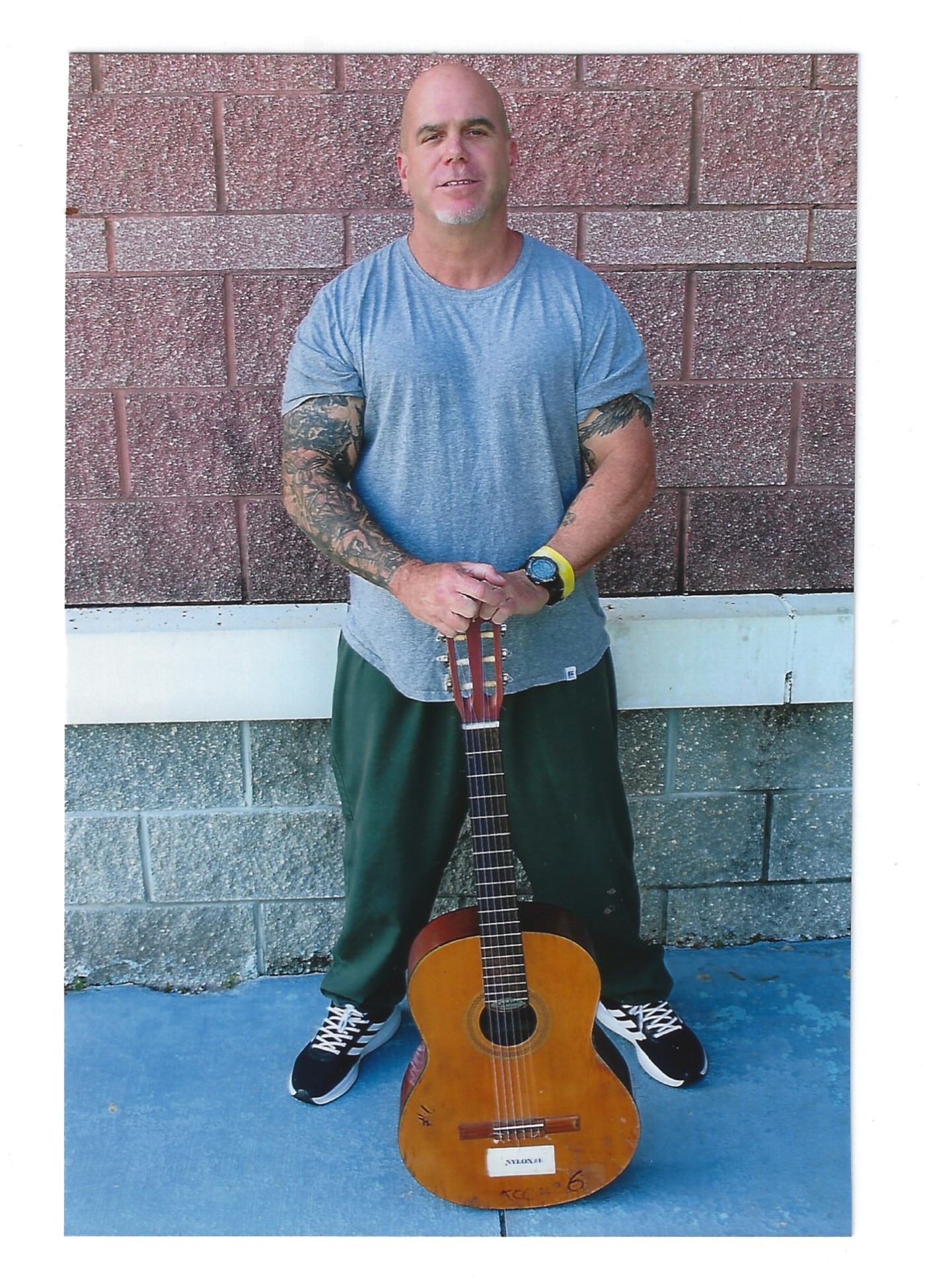
I’ve been playing a lot of guitar lately. One of the perks of federal prison. The lead guitarist of the band I’m in is named Vinny. At first, I wondered if he was Italian, but it turns out that Vinny is not short for Vincenzo. It’s a nickname. Short for Venezolano. He’s from Venezuela.

If right now you’re thinking “Uh oh. Venezuelan immigrant. Bad hombre alert . . .” that’s understandable, I guess. Between some of the recent tragic news stories and Trump’s alarmist, broad-brush declarations of murderers and rapists, it’s easy to dismiss entire nationalities as horrible people. But for the record, dude is the exact opposite of all that. A gentle spirit who loves rock-n-roll, hates drugs, and teaches a GED class in the education building.

The other night after two hours of Skynyrd’s “Simple Man,” Clapton’s “Cocaine,” Stone Temple Pilots’, “Plush” and Velvet Revolver’s “Fall to Pieces,” we were unplugging amps and wrapping mic cords when he started telling me about a Guns N’ Roses concert in Caracas in the early ’90s. The venue was one of those massive South American soccer stadiums. When Axl sat down at the grand piano and played the opening notes of “November Rain,” the sky opened up and a light drizzle began to fall over the 100,000 people in attendance.

As he was telling me this story, I tried to imagine all those G N’ R fans down near the equator. Which made me think of the time I heard Shakira, the pop star from across the Venezuelan border in Colombia, cover AC/DC’s “Back in Black.”  Then I remembered that Kim Jong Il was a huge Elvis fan and that his son, Kim Jong Un, loves the former Chicago Bull, Dennis Rodman. Muhammad Ali’s Thriller in Manilla and Rumble in the Jungle, Michael Jackson’s Bad world tour, Levi’s jeans, Coca-Cola, Motown, muscle cars, baseball, breakdancing, Mississippi Delta blues, Metallica, the Empire State Building, Microsoft, Google, Amazon . . .

Once upon a time, this nation’s greatest export wasn’t any single commodity. It was what rock-n-roll and Levi’s and Coca-Cola represented: The American Spirit. We were the envy of the world. A shining example of everything a free country could be. And as a result, the Berlin wall came down, the cold war ended without a shot being fired, and McDonald’s started popping up all over what was once the U.S.S.R.

But think about it. What have we been exporting lately? School shootings, Capitol riots, border chaos, Fentanyl overdoses, MSNBC, Fox News, hate, division, a citizenry at each other’s throats…

I remember being shocked when the news broke about a horrific school shooting in Thailand last year. Thailand? This was followed by a similar incident in Prague, the first in that country’s history. How many capitol riots—or “sightseeing tours,” if you prefer—have there been since January 6, 2021? I know of at least two: one in Brazil not too long afterward, and there was another last week in Kenya. Coincidence? Probably.

But it’s no coincidence that far right movements and authoritarian strongmen are popping up all over the globe. In the great geopolitical game of Follow the Leader, America sets the tone.  We are the world’s longest running democracy. And for decades our quality of life has been the most powerful argument against dictatorships, autocracies, and communist systems of government.

Liberty, Justice, Honor, Opportunity—these are more than just flowery ideals. They are what make us uniquely US. And they are what inspires the rest of the world to want to be like us. The hope and promise of freedom is our greatest export. Let’s not piss it away.

—July 12, 2024

1 4 5 6 23