Skip to content

Cruel and Unusual

Teenager legs with jeans and sneakers dangling from a wall.

The Supreme Court recently agreed to hear arguments in their next term about a Tennessee law that restricts surgeries for transgender minors as well as other treatments like puberty blockers and hormones.

Am I missing something here? This should be the easiest decision in the history of the high court. A 9-0 slam dunk and an early lunch for the justices.

Tennessee’s Attorney General said the state wants to “ensure that potentially irreversible sex-transition procedures are not provided to young people who may not fully grasp the lifelong consequences and risks.”

It speaks volumes about the overall health of our nation that such a thing would require a law. Much less warrant a Supreme Court battle. My only question is—Is eighteen even old enough to grasp the finality and magnitude of such a decision?

As someone who closely follows SCOTUS rulings in cases involving LWOP sentences (life without parole) for young offenders, I’ll concede that at the moment the legal answer is yes. But a growing amount of neuroscientific research and findings say otherwise. Many of these specialists have written amicus briefs for the court contending that the age at which the adolescent brain reaches maturity is actually closer to 25.

Most conservatives would agree that Justice Sotomayor is the most liberal justice on the court. I like her. Always have. And I usually agree with her. Check out what she has to say about the juvenile brain in her scathing dissent of Jones v. Mississippi, a case where the conservative majority ruled 6–3 in upholding the life sentence of a fifteen-year-old.

“. . . First, as any parent knows and as scientific and sociological studies have confirmed, juveniles are less mature and less responsible than adults which often results in impetuous and ill-considered actions and decisions. Second, juveniles are more vulnerable and susceptible to negative influences and outside pressures and have less control over their own environment. Finally, the character of a juvenile is more transitory than that of an adult…”

These three signature hallmarks of youth are not merely the observations of the court’s most liberal justice in a fiery dissent. They are stare decisis. Established law. The landmark decision in Roper v. Simmons (2005) uses these same characteristics to outlaw the death penalty for minors. Graham v. Florida (2011) relies on them to ban life sentences for non-homicide juvenile offenders. Miller v. Alabama (2012) held that a mandatory life sentence for any juvenile defendant, regardless of the crime, is unconstitutional. In the court’s opinion, this violated 8th Amendment protections against cruel and unusual punishment.

I don’t know about you, but it’s hard for me to imagine anything more cruel and unusual than a doctor performing a double mastectomy on a confused teenage girl . . . A girl who may feel strongly about something today, only to have those feelings fade entirely by the next school year.

Again—

  • Less maturity resulting in ill-considered actions and decisions
  • More vulnerability and susceptible to outside pressures
  • Character that is more transitory than that of an adult

A season of Hello Kitty turns to Roblox turns to varsity soccer. Blond hair and braces in middle school become a dyed black pixie cut and a nose ring in the eleventh grade. Kids go through multiple phases on the road to adulthood. They are works in progress constantly falling for the illusion that they are finished products.

Maybe this is an oversimplification of a more complex issue. I won’t pretend to know what it’s like to be a teenager in 2024, with all the pressures of high school and social media. And I definitely don’t know what it feels like to be convinced that the opposite sex is trapped in my body.

But I know exactly how it feels to be isolated . . . to feel anxious and awkward and dissatisfied with life, to seek an identity other than white boy Chris; be it musician, drug addict, armed robber, or Malcolm Ivey. I know how it feels to hurt. For years. And what it is like to eventually find peace. To reconcile inner with outer. No surgery required.

America has been failing her children for quite some time. Check out the massive carbon footprint we’re leaving. The leaders we elect. The examples we set. I recently read a study that found that over thirty percent of adolescent girls have considered suicide in their short lives, a rate that rivaled that of combat veterans. This should not be. Not in the greatest country in the history of the world. Saving our kids is the most important issue on the docket these days.

There is no them. Only us.

—July 10, 2024

Help Is on the Way

Image of Senator John Fetterman, rooftop with an Israeli flag.
John Fetterman, rooftop with an Israeli flag.

I’ll admit it. I’ve been having a slight existential crisis these last few months. Part of it is due to the fact that I spend most of my days locked in a cell listening to Fox News Radio. Not exactly easy listening for moderate Democrats. Of course, I flip over to NPR occasionally but hearing Terry Gross politely interview some lesbian poet just lacks the apocalyptic pyrotechnics of Jesse Kelly raving about the “Demonic Left.”

Another contributing factor is the growing fatigue from arguing with my fellow prisoners that despite Trump’s First Step Act, despite his endless bemoaning the Justice Department and court system, despite his pardoning of Kodak and Weezy, and despite his own recent criminal convictions; a meandering and geriatric Biden is still the better choice for President, if only for the District, Appellate, and Supreme Court judges he will appoint.

If this sounds like a hard sell, you have no idea.

Recently I wrote about mental maps and how often we ignore incoming information simply because it runs counter to the story we are telling ourselves in our heads. For years, I have rejected the narrative that modern American conservatism has the market cornered when it comes to strength and masculinity. In the face of almost every other song on country music radio, every Clay Travis and Buck Sexton mention of “liberal wimpiness,” every cringe-inducing progressive squad soundbite from Capitol Hill—I have stood firm.

But a few weeks ago, a couple back-to-back news stories forced me to pull my bald head from the proverbial sand. The first was about Trump getting a standing ovation at a Jersey UFC fight. The second was about an LGBTQ parade. These diametrically opposed headlines illustrate and underscore the gravitational force of the Republican Party on the American everyman, regardless of race.

In reality, true strength transcends party affiliation. Picture a soldier carrying a fallen comrade off the battlefield, a cop wading into danger to protect innocent lives, a dad pulling sixty-hour work weeks to support his family, a grandmother taking in the children of incarcerated and addicted parents . . . As I read back over these examples, it occurs to me that there is a parallel through-line running side by side with my understanding of strength—selflessness.

If you are one of the few remaining American male Democrats, and you’re reading this, it’s what drew us to the party, right? Human rights, civil rights, workers’ rights, the elderly, the poor, the marginalized, the mentally ill, and for me at least, the prisoner. Stalwart souls who dedicate their lives to championing the rights of fellow struggling citizens are unbelievably strong. They are unsung American heroes. Badasses.

But again, perception trumps reality. And the current perception is that real men make their political home on the right. The party of God, guns, and country. The party of hard work and cold beer. While on the emasculated left, we have what? Transgender bathroom rights and Palestinian protests.

Recent polls show Trump leading in every battleground state and making significant inroads into long-held Democratic strongholds. Pundits will claim this is due to Biden’s incoherent debate performance, and the party appears to be on the verge of a palace coup to unseat him as the 2024 presidential nominee. But while a quarterback change this late in the fourth might be enough to pull off a thrilling came-from-behind victory in November’s electoral Super Bowl, long-term there are other problems that can no longer be ignored. Not just messaging problems. Core, fundamental, philosophical problems. One of which is that in their burning desire to appear all-inclusive, the DNC has effectively excluded the American male.

Although my access to the free world is limited, I doubt I am the first to have grappled with this. In this nation of 330 million, I’m sure there are other centrists, moderates, independents, and never-Trumpers feeling this way. If so, take heart. A six-foot-eight, pro-Israel, criminal-justice-reforming, glimmer of hope has arrived . . . in a hoodie and shorts.

John Fetterman might just save the Democratic Party.

—July 4, 2024

Maps

Person in a field holding a globe at their side.

Imagine it’s the year 1624 and you and I are kicked back drinking ale in our powdered wigs when suddenly I take my feathered quill, dip it in ink, and draw you a detailed map of what is now the state of Florida. With one glaring exception… You lean over the flickering candle and frown at the southernmost tip of the peninsula. “Bravo, Malcolm. Well done. However, you appear to have forgotten the tiny string of islands at the bottom.”

I could do one of two things with this new information—investigate and eventually expand my map to include the Florida Keys, or slam down my map, cry “balderdash!” and deny their existence. But I could only deny for so long. At some point it would become absurd to continue to exclude these surveyed, documented, inhabited little geographical facts from my map.

Fifty years ago, psychologist M. Scott Peck was working on a groundbreaking book titled The Road Less Traveled . . . a book that, if released today, college kids would probably call “cringy.” There are admittedly some awkward passages that do not stand the test of time. But again, it was written in the 1970s. “The past is a foreign country. They do things differently there . . .” However, there is one concept that has stuck with me ever since I closed the book and put it back on the library shelf. It’s the idea that our belief systems are a kind of mental mapping and that we are the ultimate cartographers.

How often do we reject incoming information—even decline to give it a fair hearing—because it confuses our brains? I catch myself doing this all the time. Especially in the sphere of politics.

Pop quiz: Who has done more for criminal justice reform? Joe Biden or Donald Trump? I can almost hear the collective yawn from the other side of your computer screens, but humor me a minute. Who do you think? If your familiar with my essays or the Miranda Rights series, then you know it pains me to admit that the answer to this question is—

The Donald . . . by a country mile.

In 2018, Trump signed into law a bill called the First Step Act. I remember hearing about it at the time, but I still had five years left to serve on a twenty-year state sentence and the law only applied to federal inmates. I just assumed it was some toothless piece of legislation that only applied to a handful of white-collar criminals.

Upon my arrival in Federal Prison six months ago, I was shocked to learn that many people have been going home early due to this law. A couple days ago, I watched an old lifer reduced to tears when granted compassionate release as a result of the First Step Act.

Maps.

Don’t get me wrong, the FSA is far from perfect. Eligible inmates must take classes to earn credits that will reduce their sentences. Unfortunately, federal prisons are so woefully understaffed that out of a 12-week program, you’d be lucky to attend a couple classes. But the framework is there. It’s something to improve upon. Something that might actually benefit society one day by turning out educated and reformed men and women back into their communities. Not yet, but someday.

A lot of my fellow inmates are convinced that if Trump is re-elected, there will be a Second Step Act that will extend beyond the current nonviolent drug offender demographic. I have doubts. Despite the fact that violent crime is down 40% on average from this time last year, the 24-hour news cycle is pumping a different reality. It would be difficult for any president to get criminal justice reform passed in the current political climate.

In addition to the First Step Act, Trump has promised to pardon all the “J. Sixers” if elected. Think those dudes weren’t happy to see Biden mumbling and stumbling over his words on the debate stage the other night?

And finally, there’s the optics of the mugshot, the 34-count indictment and subsequent guilty verdict, the upcoming sentencing hearing . . . the growing consensus is “Trump feels our pain.” And while I strongly disagree—to feel someone’s pain requires empathy, and the former President has never demonstrated anything remotely close—sometimes perception outweighs reality.

I think Biden understands this better than anyone right now.  Perception outweighing reality could be the theme of this election season. If Joe had been thinking clearly on the debate stage last week, he would have told America about his historic infrastructure bill, he would have touted his brazen CHIPS Act, record unemployment, the successful tightrope act of dodging a recession while taming inflation, the booming stock market, plummeting crime rates . . .

And it wouldn’t have made a lick of difference.

Why?

You already know the answer.

Maps.

—July 2, 2024

Available Now!

Letters to the Universe: Essays on crime, craft, and the middle way, 2014-2023


Excerpt from Letters to the Universe, available now at Amazon

I think I had been up for four days when I robbed the second gas station. But it could have been five days or even six. I don’t know. Days run together when they’re not separated by sleep. Armed robbery was a new low, even for me, but then so was crack cocaine. In the six months following my first hit from a crack pipe, I’d lost everything—my car, my job, my girl, my family. I couldn’t stand the weak thing I had become, and by then, I was ready to die. My plan was simple: rob and get high until the police got behind me, then blow my brains out.

Although cocaine is not classified as a hallucinogenic, sleep deprivation most definitely is. And as I was exiting that gas station, I was seeing and hearing all sorts of things—police search lights, sirens, footsteps, voices . . . I hopped into a stolen car and sped away, zigzagging my way through neighborhood streets and charting a course for the nearest dope hole.

As I pulled out onto the main thoroughfare, two things happened that would change my life forever: 1) my headlights stopped working, and 2) a cop was driving by. I checked the rearview to see if he was going to turn around. Of course he was. It was 3 a.m. and I was driving with no headlights in an area where a robbery had just occurred. When he turned on his siren, I stomped on the gas and yanked hard on the steering wheel . . .

. . . and drove straight into a brick mailbox. I bailed out of the car and ran through someone’s yard, tires screeching behind me. Desperate to escape, I sprinted toward the field abutting the backyard but never saw the fence. It was one of those waist-high, rusty barbed wire things and it flipped me upside down. I felt the gun fall from the pocket of my hoodie into the tall grass below. I quickly freed myself, then frantically groped for it in the dark. I couldn’t lose the gun. I needed it to off myself when there was nowhere left to run. But I heard squawking radios and jingling keys approaching. I had to go.

Branches and thorns slapped my face as I tore through the field. I tripped, lost a shoe, tripped again, and finally rolled into a gully and pulled the brush over myself to hide. An hour passed. Helicopters flew overhead, far-off voices shouted, car engines roared. Then the low growl and panting breath of a dog drew close. I could hear it a few feet away, tracking me. Suddenly, the massive head of a German Shepherd poked through the brush. I threw my arms up to keep him from biting my face. He seized my wrist and began ripping flesh from bone. I was quickly surrounded by police and pummeled with flashlights and boots.

But something strange happened in that field. Maybe it was just the dope or the sleep deprivation. Maybe I was in shock, but for a moment, I was hovering over my body, looking down at the scene below. This pitiful crackhead that was me—emaciated, dirty, bloody—being mauled and stomped and finally handcuffed.

If I’d had that gun while I lay there in the bushes with the police closing in, I would have killed myself. There would be no Consider the Dragonfly, no With Arms Unbound, no On the Shoulders of Giants, and you definitely wouldn’t be reading this right now. I’d be just a forgotten news story from the last decade, a dead crackhead in a field. Forgotten, except to my mom, and she would have found a way to blame herself. Instead, it is my belief that something bigger intervened and that has made all the difference. If Malcolm Ivey has a birthday, it’s March 21, 2005, the night I dropped the gun.

—from Divine Intervention, April 2017

Letters to the Universe

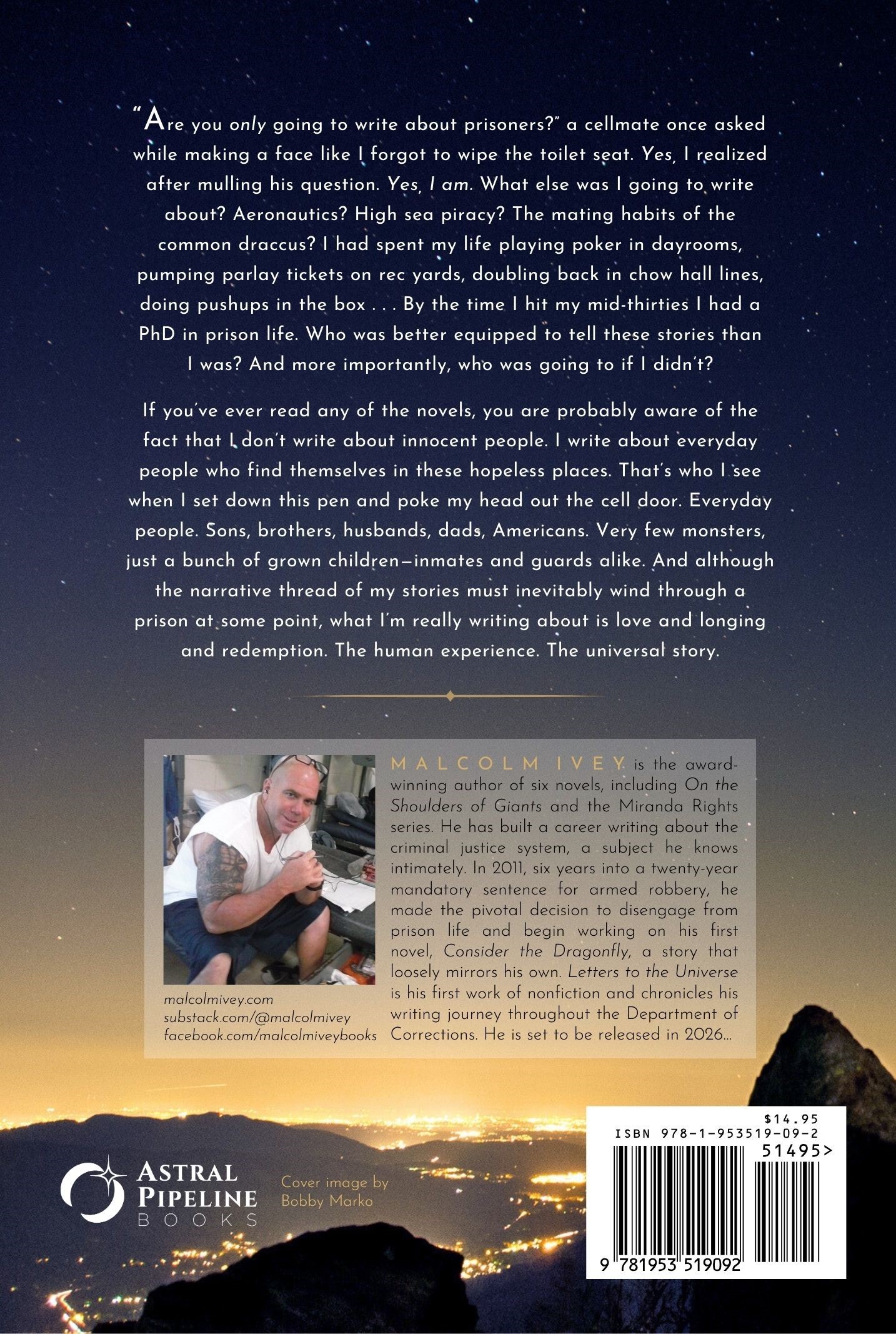
Cover image for "Letters to the Universe" showing a mountain peak mailbox against a starry night sky.
(Cover image by Bobby Marko of wefoundadventure.com)

I was pissed when Colson Whitehead won the Pulitzer Prize in 2020 for his best-selling novel, The Nickel Boys. I remember listening to his interview on NPR’s Fresh Air while quarantined in a prison on the Florida Panhandle during the height of Covid, feeling the way an overzealous sports dad must feel when someone else’s kid wins the MVP. His critically acclaimed novel—and second Pulitzer—was set against the backdrop of the Arthur G. Dozier School for Boys, a subject I explored four years earlier in a book I consider to be my life’s work, On the Shoulders of Giants.

There was something intrusive about this darling of the New York literati writing about incarcerated youth in Florida. Like a rival gang member who wandered onto the wrong side of the yard (or a Walmart going up across the street from a local independent grocer). The thing that really grinded my gears was that Dude never even bothered to come down here to tour the cottages or the unmarked graves or the infamous White House.

Of course, I was being irrational, not to mention hypocritical and territorial. Fiction writing, the best of it, turns on imagination and empathy and research. Did it matter that he wasn’t from the Sunshine State? Or that he had never spent time in a facility like Dozier? Hadn’t I written essays slamming cancel culture for attempted takedowns of other authors for similar transgressions? Half of my beloved Giants is written in the point of view of Pharaoh Sinclair, a young black man from the Azalea Arms housing project. To my knowledge, Colson Whitehead has never written an op-ed accusing me of cultural appropriation.

I didn’t care about any of that at the time. I just wanted some love for my book. And aside from my state-raised brothers and sisters and a handful of Facebook friends, my Pillars of the Earth, my Led Zeppelin IV, my David was toiling away in obscurity, unnoticed and unread. I think I even sent Terry Gross a copy at WHYY in Philadelphia. No response. Such is life for a self-published and incarcerated author. (Sidenote: The following year, Giants did win first place in the Mainstream/Literary Fiction category of the Writer’s Digest Self-Published book awards. A longtime goal and major milestone in my world. But let’s be real—there’s an Everest of altitude between a WDSPBA and a Pulitzer.)

In fairness, I can’t say that Mr. Whitehead is undeserving of the accolades since I’ve never read his work. I plan to though. Some of the best novels I’ve read over these last 18 years in prison were PulitzersJunot Diaz’s The Brief Wondrous Life of Oscar Wao, Donna Tartt’s The Goldfinch, Anthony Doerr’s All the Light We Cannot SeeMaybe The Nickel Boys will be an upcoming Astral Pipeline Book Club selection. We’ll see if it can stand shoulder to shoulder with these modern classics.

But as I was thumbing through my almanac looking at the various awards for writing—the Pulitzer, the Nobel, the Man Booker—a phrase winked up at me from the page. It was in the National Book Award section. In the fine print below the heading were the words Distinguished Contribution to American Letters.

Letters… Shonda would call this a breadcrumb. A little something from the Universe to let me know I’m on the right path. I thought I was the only one who referred to my novels and essays as letters. Apparently, this was a thing long before I wrote the first words of Consider the Dragonfly. Like centuries before. One of the definitions of letters in the Oxford Dictionary is “literature.” The irony here is that my writing style—if I have a writing style—was cultivated and refined over decades of writing actual letters. Hundreds of them. Letters dating all the way back to the Dade Juvenile Detention Center in 1987; many to strangers, mostly unanswered. Until one day when I decided to write the world a letter in the form of a book.

Hard to believe I’m now on the verge of releasing number seven, a hybrid memoir and essay collection that spans the final nine years of a twenty-year mandatory prison sentence, an era in which I learned to conquer my demons through the redemptive power of writing. Is it Pulitzer caliber? Probably not. But it’s a massive accomplishment in my little corner of captivity, a bookend to a fantastic journey, the best I could do between the years of 2014–2023.

Letters to the Universe, available this Fall from Astral Pipeline Books.

Coming Soon!

Letters to the Universe

Hard to believe I’m now on the verge of releasing number seven, a hybrid memoir and essay collection that spans the final nine years of a twenty-year mandatory prison sentence, an era in which I learned to conquer my demons through the redemptive power of writing. Is it Pulitzer caliber? Probably not. But it’s a massive accomplishment in my little corner of captivity, a bookend to a fantastic journey, the best I could do between the years of 2014–2023.

Letters to the Universe, available this Fall from Astral Pipeline Books.

(Cover image by Bobby Marko of wefoundadventure.com)

Moving On

Once upon a time, before the iPhone, before Facebook, before Hurricane Katrina, back when George W. Bush was still President, I plead guilty in both state and federal court to a boatload of charges including armed robbery and possession of a firearm by a convicted felon. I didn’t hurt anyone. Not physically at least. And the sum total of my ill-gotten gains amounted to a couple hundred dollars. Enough for a few more pieces of crack. I would’ve come out better shoplifting at Walmart. Embarrassing to admit that I was once so desperate, so enslaved, so ignorant that I could sink to this level, but it’s part of who I am, part of my story. I own it.

The state sentenced me to twenty years mandatory. The federal government gave me 379 months. Luckily, the sentences were run concurrently. (If there’s anything lucky about receiving 31 years in prison.) I still remember the conversations when I returned to my cell on the sixth floor of Castle Greyskull. “Dude, you signed a deal for all that time? Are you crazy? Thirty years ain’t no deal. That might as well be a life sentence. I would’ve took that shit to trial!”

This was the general consensus. And my fellow inmates had a point. But they didn’t have all the information. The evidence against me was overwhelming—video surveillance, a gun with my prints on it, not to mention my own confession on the night of my arrest. Plus, I was just tired. Weary. The free world was apparently not for me. I had already served from ages 18 to 28 in prison and upon my release I quickly became hooked on crack, crashed multiple cars, received 70 staples in my head, mangled every relationship I had, got mutilated by police K-9s, and lost everything. My friends, my girl, my self-respect. I was ready to lay down.

And then there was mom. The sweet lady who never missed a court date, never missed a visit, never stopped believing in me. Arguably the victim who has suffered most from my crimes. She was 58 at the time. If I could make it home in 30 years, she would be in her 80s. Maybe I could cut her grass, work in her garden, clean her drainpipes, take care of her when she was old and needed me. One last shot to come through for her the way she always came through for me. One last chance to do something honorable and reciprocate the unconditional love that has been shown to me my entire life.

So I copped out. All those years ago. And for close to a couple decades I’ve been doing my time like it was a life sentence, but with a happy ending. I don’t do calendars. Never have. And I don’t pay much attention to my release date. I just look forward to the next visit, the next football game, something in the very near future. Every once in a while, I’ll raise the periscope and scan the horizon. When I passed the ten-year mile marker it was a noteworthy event. But I still had close to another decade to do in state prison plus a 2032 release date in the federal system. Then, in 2016, a Supreme Court ruling rendered an enhancement of my sentence illegal, and my fed time was dropped from 379 months to 288 months (24 years!). This meant that once I finished my state bid, I’d only have a couple years to do in the feds. Time marched on. Visit by visit, book by book, year by year. Since my state sentence was twenty mandatory, the release date on my monthly gain time slip never changed: 10/25/2023. This was the first finish line. When Sticks & Stones came out in early 2018, I had five years and nine months left to serve. “Five and some change.” When Year of the Firefly was released, I had two years and some change. Weight of Entanglement (2022) was a year and some change. And ever since October of last year, it’s just been “some change.”

I still try not to pay much attention. I keep my head down, work on these books and essays, look forward to another Saturday eating microwave food and drinking coffee with mom, another Sunday of Miami Dolphins football. I’ve still got a little fed time left to do before I make it home. But I just slipped under the 30-day mark in state prison. Pocket change.

The finish line is in sight.

I’m moving on.

Recent photo of me and mom at visitation

‘The Universe’

Excerpt from my upcoming hybrid memoir

Greetings, friends. It’s been a minute since I’ve been on here sharing anything new… February, to be exact, when I posted my last essay Take Me To Church. A move and a new job assignment have kept me away from my desk quite a lot these past few months. But I’ve been writing when I can, dividing that time between the third installment of the Miranda Rights series and a new project—a hybrid memoir that began as an anthology of essays and has grown from there. Here’s an excerpt from the latter, the opening paragraphs of “Part One: Letters to the Universe”…


view of mailbox and starry night sky
(Image by Bobby Marko of wefoundadventure.com)

The Universe. It’s such a trite and new-agey catch-all, isn’t it? Something David Mitchell’s Dwight Silverwind might allude to with a sublime smile as he sinks into the lotus position and contemplates the mystical beyond. What does it even mean, the Universe? Vast, infinite space? The cosmos? Every spinning planet, every cratered moon, every lonely star? That’s part of it, I think.

The chain gang etymologist in me wants to dissect the word, to separate prefix from root. Uni-verse. Uni meaning “one,” and verse meaning “song.” One song. One continuous freestyle of a song echoing down through the centuries, pulsing in the present, and unspooling out over the horizon into the distant future. A collaboration in which every living organism that ever was and will ever be is a featured artist. I dig this interpretation. But is it true? Maybe. But only in the abstract.

Is it merely another way to approach the idea of a divine architect? Like in Giants when Pharaoh wondered why Izzy was always popping off about “the Universe” when it was obvious that he really meant God. This rubs closer against the truth. Still, to reduce the full weight of the concept into some generic euphemism for the Creator is to remain wide of the mark.

It could be that the Universe will always mean different things to different people. We may just have to leave it there. But before my ADHD kicks in and sends me bounding off in the direction of another shiny thought, I want to state, for the record, my understanding of the word. Especially since it’s emblazoned across the cover of this book.

When I say Universe, I’m talking all of the above. From the great spiral galaxies to our ancient ancestors to every living being currently inhabiting this blue-green rock we call Earth. Every charged particle, every blade of grass, every pulsation of light and vibration of sound. And yes, the divine intelligence and order behind it all. This is what I mean by “the Universe.”

But I don’t worship it like a god. Nor do I fear it. I just trust it. And I believe there is magic in our connection to it.

When there is a burning desire within us, and this desire is colored with emotion and concentrated into powerful thought waves that are then bounced off a satellite in some distant outpost of the same Universe, they eventually boomerang back to us, manifesting in our lives, pointing the way forward, and revealing the obstacles that run counter to the fulfillment of this profound need, whatever it may be, until the mission is successful.

But it’s not all wanting and wishing and waiting. There are other key ingredients as well; blue collar principles like discipline and sacrifice immediately come to mind. And faith. Faith is mandatory. “Live as if the Universe is rigged in your favor,” Rumi whispers across the oceans of time. I hear and obey.

Take Me to Church

Man praying beside a lake at sunrise.

The Florida Department of Corrections was established in 1868. It says so right on the logo. That’s 155 years of misery bound up inside these razor wire fences; 155 years of blood and tears and beatings and cover-ups, of roach- and rat-infested dormitories, sub-standard medical care, untreated mental illness, salmonella diets, and a workforce trained to hate.

Not complaining. People have been complaining since 1868 and it’s done no good. This is just the way it is. This is the prison system I grew up in. I first arrived at Lake Butler on a county van in 1993 to serve a decade. Then I returned in 2005 and I’ve been locked up ever since. I’ve wasted most of my life on the rec yards and in the dayrooms of the Sunshine State’s correctional institutions. Close to 30 years. Damn near one fifth of the Department’s bloody history. Lots of changes during that time: secretary changes, legislative changes, policy changes, uniform changes… But if there has been one constant over the years, it’s the good Pentecostal and Baptist folks that come in every Sunday to minister to my broken brethren.

“Fellers,” I remember one old country preacher saying as his wife beamed at us from the piano, “I could be wearing them blues just like you. And sitting in them same pews. The onliest difference is I didn’t get caught. And I found Jesus before that old devil could get his hooks in me good…”

Sunday after Sunday, rain or shine, they would arrive with a message of love and hope and forgiveness. Some of the greatest hits: that all have sinned and fallen short of the glory of God, that Paul was a murderer and the Lord still used him to do great works in the early church, that Jesus was crucified between two common criminals and he promised them a place in paradise on that fateful day…

These people would hug you, call you “brother,” pray with you, make you feel less alone in the world. God’s love was more than just an abstract idea in those services, more than just some ancient mythology on a Dead Sea Scroll. It was a palpable presence that filled the room, emanating from their smiles and pulsating in their hugs and handshakes.

But then a darkness crept over the land. Religion and politics intertwined. God’s all-encompassing love was suddenly limited. There were terms and conditions to salvation. Sure, the Sermon on the Mount was still relevant and, yes, Jesus’s greatest commandment was still to love one another. But there was also Levitical fine print that could not be ignored. Certain restrictions applied.

At least this is what I assumed was going on in recent years. Especially when the evening news ran a segment in 2019 about a pastor getting booed by his congregation for calling out former President Trump on his lack of humanity. Compassion was dead and division ruled the day. No shelter, no quarter, no love. Even the Church had succumbed. Matthew 25:35-45 had no place in the modern American landscape. Not in these hateful and hyper-partisan times. But again, this was all conjecture. All theory. I haven’t been to church much over the last couple decades. Practically zero attendance on this bid. Up until recently. (More on this in a couple paragraphs.)

Everyone is Christian when the handcuffs get slapped on. God is like Momma—the last person you think about when you’re out there doing dirt and the first person you call when they throw you in a holding cell. Lord knows how many calloused and trembling hands I held in county jail prayer circles back in the day. Full of desperate men like me petitioning the man upstairs for a little mercy. Staring down the barrel of life in prison will make a born-again Christian out of even the most devout agnostic.

But then we get sentenced and sent down the road. And as we work our way through the post-conviction process, our hope and faith evaporate with every denied appeal, every deceased loved one, every unaccepted phone call and unanswered letter. Not everyone though. My friend Lester Wells has not missed a church service since he came to prison in 1983 for a crime he insists he did not commit. Forty years in a cage and his faith has not wavered. Even though he’s lost everything. Hard not to draw book of Job parallels when I see Mr. Wells praying in the mornings.

My situation is different. I am not an innocent man. I’m guilty of 99% of the crimes I’ve been charged with, and the list is substantial. Not proud of this but there’s no getting around it. No one to blame but me. In fact, that one percent that I’m actually innocent of is offset by the few things I managed to get away with. So it all balances out. Especially when you factor in the crimes that weren’t technically crimes but in many ways were worse than the burglaries and robberies that put me here—the women I used for sexual pleasure and ego gratification, the lost souls that I could have affected positively but instead infected with the miserable slavery that is addiction, the lies I’ve told, the people I’ve let down, the disgrace I’ve brought upon my family… So when that great white-bearded cosmic wish-granter in the sky opted not to rescue me from the colossal mess I made of my life, I accepted my fate with no hard feelings. After all, I’m the one that put me here.

But I haven’t been hanging out in church. For these last eighteen years I’ve just been making the best of this bad situation—playing soccer, playing poker, doing pullups and dips, gambling on football, hanging out with Momma on Saturdays, doing my time… Then, a little over a decade ago, I started writing these essays and books which proved to be a watershed moment on the timeline of my incarcerated journey. This led to an interest in self-improvement, the study of philosophy, mindfulness meditation, neuroplasticity. The Law of Momentum is not just the working title of book three in the Miranda Rights trilogy, it’s a powerful force that can carry us to both dizzying heights and crushingly low depths. It all depends on which way you get moving.

But momentum is also a strange and mercurial current. It can shift like the wind. This is especially evident in sports. Take football, for example. One team is racking up chunk yardage, going up and down the field, scoring almost effortlessly. But then the opposing team digs in and forces a goal line stand, then drills a long field goal just before the half, then forces a turnover to open up the third. Suddenly, they’re only down ten points with the ball at midfield and an entire half to go. What happened? Momentum shifted.

I experienced a momentum shift of my own recently. Things were humming along. I was working on my seventh novel, pumping out these essays, surging toward the finish line of this lengthy prison sentence, when I made a couple questionable decisions. Nothing major—a joint here, a bottle of buck there, cranking up my old parlay ticket for one last run. But it was enough to stall my momentum. And after a few repetitions of these old behaviors, I was moving in a completely different direction: backwards.

Things got real bad, real quick from there. (For a more detailed account of this unraveling, check out Divine Intervention Part Two.) The point is that I had to do something drastic to shift the momentum. I needed a goal line stand. So on Sunday, November 13th, 2022, I signed up for church. First time in forever. Just to change up the energy. Just to escape the hovering dope smoke of my unit and sit in a pew for an hour. Just to be around some positive people.

And do you know what I discovered? Those same volunteers are still showing up every weekend. Those same country preachers and their piano-playing wives. And they’re not interested in politics, or who’s Baptist or Catholic or a Messianic Jew. They definitely ain’t in it for the offering plate. They’re just living Matthew 25, spreading a message of unconditional love and hope to us, the least of their brothers.

I’ve been going for a few months now. I won’t pretend it’s always awesome. Sometimes it’s boring, sometimes I disagree with the message, sometimes I’m grumpy because I have to miss football. But I always feel better for going, I remain clean, and most importantly, I got the momentum shift I was seeking.

I’ll leave you with one of my favorite passages from Michael A. Singer’s The Untethered Soul.

“Your relationship with God is the same as your relationship with the sun. If you hid from the sun for years and then chose to come out of your darkness, the sun would still be shining as if you had never left. You don’t need to apologize. You just pick your head up and look at the sun. It’s the same way when you decide to turn toward God—you just do it. If, instead, you allow guilt and shame to interfere, that’s just your ego blocking the divine force. You can’t offend the Divine One; its very nature is light, love, compassion, protection, and giving. You can’t make it stop loving you. It’s like the sun. You can’t make the sun stop shining on you; you can only choose to not look at it. The moment you look, you’ll see it’s there.”

1 5 6 7 23