Skip to content

Fixing a broken prison system

An inside perspective…

Part 11 – Not long after I began working on this series, I noticed an interoffice memo in the shakedown room at the visitation park at Santa Rosa Correctional Institution, dated July 2015. It stated something to the effect of “The culture of abuse that has plagued and permeated the Florida D.O.C. for decades will no longer be toleratedโ€ฆ” The memo was signed by the newly tapped secretary, Julie Jones, the first female to head the department in its 150-year history.

It was ironic reading a memo like this at Santa Rosa Main Unit. The place where the show Lock Up was filmed, where close management wings are painted with slogans like “No guns. Just guts. Toughest beat in the state.” And the sidewalks are stained with inmates’ blood.

I did what I assume most other convicts did โ€“ as well as tenured employees from sergeants to wardens to regional directors when they saw this memo. I smirked. Did this lady really believe she could eradicate the systemic evil and good ol’ boy modus operandi of the D.O.C. with a mere memo? Unlikely. The culture of abuse she cited was as Floridian as orange groves and the Everglades. The prison system didn’t earn its Department of Corruption nickname for being humane and transparent.

Turns out it was more than just a memo. In her first few years on the job, Ms. Jones has backed up her vision with cameras in every dormitory, plus audio in every confinement unit. The training emphasis seems to have shifted from force to empathy, many of the issues raised in this series โ€“ tablets, technology, mental health, better food โ€“ have been rectified under her stewardship and there are rumors of new rehabilitative programs on the horizon.

Winston Churchill famously once said: “This is not the end. This is not even the beginning of the end, but perhaps this is the end of the beginning.” Fixing a broken state agency is no small task. It all starts with a leader. Just as perennial bottom-feeder NFL teams are transformed by forward-thinking general managers and downtrodden companies are reinvigorated by visionary CEOs, the Florida Department of Corrections needed a trailblazer to lead the way out of the wilderness. I believe they found that person in Julie Jones.

[This post was previously posted on 12/22/17 as Part 11 of Malcolm Ivey’s series “Fixing A Broken Prison System”, which appears under its own tab on this site.]

Fixing a broken prison system

An inside perspective…

Part 10 – I did my first bid in the Florida Department of Corrections during the 1990s, a grueling 10-year odyssey that began at age 18 and ended at age 28. I didn’t have to serve all those years. With gain time I could have been home after serving less than half of my sentence. But I was young and hard-headed and I liked to smoke pot.

Since the introduction of the random urinalysis program in 1994, the department of corrections has aggressively gone after incarcerated drug users. The penalty for a failed urinalysis carries 60 days in disciplinary confinement and 180 days loss of gain time. I failed a total of seven drug tests over that decade, costing me 1,260 days. In other words, I spent three-and-a-half extra years in prison because I stubbornly insisted on smoking marijuana despite the mounting negative consequences (cue the definition of insanity clichรฉs). Then I got out and graduated to bigger and better drugs.

Today, I am 13 years into my second prison sentence. Substance abuse is no longer an issue. Writerly aspirations have transformed me into a paranoid hoarder of my remaining brain cells. Still, every few months, my name is called for a random urinalysis. My biggest worry is no longer failing one of these things, but rather failing to submit in the rigidly allotted one hour. This is considered refusal and thus carries the same penalty as a sample that comes back dirty.

Here’s the rub: no one ever tests dirty anymore. Not because the entire prison population has experienced a spiritual awakening, not because we’ve been rehabilitated, not because we now refuse to indulge in counter-productive, self-destructive behavior. But because the most popular, most prevalent and most dangerous drug in Florida prisons doesn’t register on the urinalysis. I’m talking about spice (See my post titled The truth about spice).

Once legal and deceptively marketed as “synthetic marijuana” because it mirrored the effects of THC and was sprayed onto a green leafy substance, the drug has morphed into something far more potent and sinister. Think PCP, acid, meth and roach spray. Every day I watch my fellow inmates vomit, seize, flop, howl, and bang their faces against steel and concrete on this scary and highly addictive substance. This is the state of the Florida Department of Corrections, 2017. The new normal. You never see or smell marijuana anymore. Even its nickname is telling. Nobody calls it weed or pot or reefer or bud these days. They call it “180” for the amount of days one loses if he fails a urinalysis. Why even bother when you can smoke spice?

But again, this is not some harmless, synthetic marijuana we’re talking about. People are dying after smoking this stuff. Two in the last month at my prison. It’s gotten so bad that legitimate epileptic seizures are being scoffed at by responding staff who assume that a convulsing inmate is merely high on spice. Gangs are now battling to control the lucrative market, there are more assaults, more thefts, underpaid officers are being persuaded to supplement their income. Meanwhile, the Florida Department of Corrections doggedly continues its random urinalysis program, spending untold amounts of tax dollars on archaic five panel track tests each year while catching no one. The only inmates ensnared in this trap are those who can’t urinate in the designated hour. Mostly awkward, shy bladder types and old men with bad prostates. The spice smokers show up wasted and pass with flying colors.

I bet the department longs for the days when its biggest drug problem was marijuana.

[This post was previously posted on 12/15/17 as Part 10 of Malcolm Ivey’s series “Fixing A Broken Prison System”, which appears under its own tab on this site.]

Fixing a broken prison system

An inside perspective…

Part 9 – For all the murders, rapes, untreated mental illness, rampant drug abuse and historically inhumane treatment of human beings over its 150 year history, one problem the Florida Department of Corrections hasn’t shared with other bloated prison systems across the U.S. is gang activity. Aside from the obligatory hate groups masquerading as religions, the Sunshine State’s inmate population has always divided itself along county lines as opposed to America’s more color coordinated criminal empires. Dade rolled with Dade, Broward with Broward, Duval with Duval. That’s about as organized as things got. For all their notoriety, the gangs of New York, Chicago, and Los Angeles could never seem to gain a toe-hold in Florida. All that has changed over the last ten years.

When I look around my dorm, I count members of six different gangs. I would name them by organization but I prefer not to be jumped, stabbed, or “buck-fiftied” (the facial slash that is growing in popularity in Florida’s correctional facilities). And since I’m a neutron โ€“ meaning neutral, non-affiliated โ€“ this could happen without repercussion. Maybe I should join a gang. I’m being sarcastic, of course, but for the hundreds of young men being bussed from county jails into Florida’s four reception centers every day, this is a very real dilemma.

Prisons make for fertile recruiting grounds. Every yard is full of inexperienced twenty-somethings with time to do. Many are hundreds of miles from home, broke, scared, surrounded by strangers in a hostile environment. This year, at the facility where I’m housed there have been more than 20 stabbings. Gangs offer safety in numbers, provide brotherhood, demand respect, and give an identity to those struggling to find themselves. Many have prominent rap stars as the faces of their respective franchises. Plus, gangs control the flow of dope into most institutions. For the average street kid coming into the system, the decision to bang can be a lucrative one.

This is a dangerous situation. Dangerous to the non-affiliated inmate population who want to better themselves or just serve their time โ€“ even their life sentences โ€“ in relative peace, dangerous to the already outnumbered guards who work in Florida prisons, and dangerous to the society that is sending away these uneducated young dope dealers, drug addicts and small-time criminals, only to have them return to their neighborhoods a few years later as focused and fully indoctrinated organized crime members.

This recent rise of gang activity is a complex problem with no easy fix. One solution may be segregation, designate a few prisons for known gang members and give the most gung-ho guards in the state hazard pay to work there. This would at least slow down recruitment. Maybe have mandatory classes that show the catastrophic consequences of gang violence, i.e. children caught in drive-bys at school bus stops, illiterate teens in bandanas with AR-15s, reformed OGs with redemptive messages. Father Greg Boyle of Homeboy Industries has done groundbreaking work in this field, the department could seek his wise counsel. Maybe men could earn their way out of a “gang camp” through good behavior, renunciation, and a commitment to speak out against gang violence.

As with any bold move, I’m sure there would be logistics to explore and legal ramifications to consider. But if the Florida Department of Corrections does not address this dire situation now, by the year 2025, Florida won’t have a gang problem, it will have a gang crisis.

[This post was previously posted on 12/8/17 as Part 9 of Malcolm Ivey’s series “Fixing A Broken Prison System”, which appears under its own tab on this site.]

The universe has a sense of humor

Besides my books, the crowning achievement of my middle-age years is the fact that I haven’t received a disciplinary report (DR) since 2009. A major feat, considering that my prison history is littered with rule infractions: contraband, fighting, multiple positive drug urinalyses, disrespect. I’ve probably been to the hole 50 times (my last stay was for eight-and-a-half months). I’ve lost all my gain time, been sprayed with gas, roughed up, cased up, stripped, shipped, and most painfully, had my visitation privileges yanked. It’s been a long journey.

And even when I started focusing on changing my thought patterns and behaviors, even when I committed to reinventing myself, there was still no guarantee that I could remain DR-free. The wrong guard in the wrong mood on the wrong day could result in a 30-day trip to the hole. There’s no such thing as innocence here. Every inmate is guilty “based on an officer’s statement.” This is not some injustice I’m lamenting. This is just part of the prison experience. This is life.

So it was a minor miracle that I made it seven years without incident. Unfortunately, that streak came to an end last month.

There’s this new rule designating the showers “off limits” from 7:45 to 8:00 p.m. for everyone except transgender inmates. Whether enacted from genuine kindness or some future lawsuit paranoia, I’m not sure. But even if it is a heavy-handed reaction to what’s going on out there in the real world, it’s probably a good rule. I mean, if it stops even one person from being assaulted or gives them a few minutes of peace and security in this hostile and violent place, it’s a good rule, right?

The reason I violated it is simple: I forgot. As I said, the rule is brand new and anyway, there were no transgender inmates living in the dorm. So at 7:55, fully soaped and mentally entrenched in the epilogue of my latest novel, I was confronted by a guard and informed that I was being written a DR for entering the shower during the transgender-specified time frame. How did he know I didn’t identify as transgender? Training? Expert analysis? He had a lip full of tobacco and a Confederate flag tat. I’m pretty sure he’s no expert on the subject.

But that’s not the story. Neither is the story my historic run of years coming to an end. The interesting thing about all of this is that the DR raised my custody level, which changed my housing level, which means I am now in a new dorm. My neighbors went from those with release dates within the next 15 to 20 years to mostly lifers. There’s an amputee to my left doing a mandatory 40, a blind man to my right who’s been in since 1986, and the dude across the aisle is fresh off death row. Ironic because the book I just finished writing includes an amputee, a blind man, and a death row subplot. Either the universe has a sense of humor, or its satellites are delayed. Where were these guys while I was researching On the Shoulders of Giants?

[This post originally appeared on http://www.malcolmivey.com 5/15/16.]

The opinionated voice in my head

I don’t know about you, but my brain came equipped with a paranoid, self-conscious backseat driver who is constantly bumping his gums about every catastrophic and humiliating potentiality that is mathematically possible in a given situation.

This is probably part of the reason why I continued getting high long after the party was over — silencing the inner noise, separating self from brain chatter. Although sometimes this backfired and the dope was like giving the voice in my head a bullhorn.

But this isn’t another of my anti-drug rants. I don’t even consider myself anti-drug. I just can’t use them. For me, drugs come with the curious side effect of landing in the back of police cars. In fact, I’m currently 11 years into a 30-year sentence for actions resulting from my voracious, insatiable appetite for mind-altering substances. But again, this is not about the drugs. This is about the voice.

If you’re thinking “Malcolm is a psycho, he’s got a voice in his head,” that would be the same voice I’m referring to. We’ve all got it. This highly opinionated, ultra-sensitive, threat-assessing, judgment-casting inner narrator who edits the inflow of the world through the senses with various degrees of inflection. Mine happened to be squawking this morning. I’ll explain…

I’ve been wanting to try yoga for a while, ever since I read Bo Lozoff’s We’re All Doing Time. I’ve been incarcerated for most of my life and I grew up hanging from the pull-up and dip bars on rec yards across the state of Florida. These sorts of exercises are a given, as routine as chow and count. There’s a reason why your crackhead nephew gets arrested skinny enough to hide behind a pine tree, and gets out with pecs like Lou Ferrigno. We get buff in here. It’s part of the prison experience.

Yoga has a different draw: flexibility, supple internal organs, reduced stress, increased energy, focus, concentration, peace of mind. At 42 years old, these things seem more important to me now than having massive biceps. So this morning I woke up, brushed my teeth, slammed a bottle of water, and settled into the Corpse pose in the space beside my bunk.

Almost immediately, the voice piped up: “You look weird, man.” I ignored it and climbed to my feet to attempt the sun salutation. The voice was silent for a moment, but by the time I reached downward dog, it was back with a nervous vengeance: “Dude, what the hell? People are staring. They’re gonna think you’re soft or gay or crazy.” The voice was right. Yoga postures aren’t exactly the most prison-friendly exercises. The last thing I wanted was some rapist checking me out while I attempted the plow.

I couldn’t help it. I opened an eye and surveyed the dorm. The guy across the aisle was zoned out on psych meds, another had toothpaste slathered over his face, the old man behind me was in a heated debate with an invisible opponent. No one was paying any attention to what I was doing.

I had to laugh at myself. Why was I sweating appearances when I live in a crazy house? Probably because my paranoid backseat driver convinced me yet again that my reputation, manhood, and very existence depended on it. Here’s hoping your voice is more laid-back than mine.

[This post originally appeared on http://www.malcolmivey.com in June 2016.]

The Behemoth and the Snowflake

They say that upon finishing a manuscript, writers should do something outside their comfort zone. Learn a foreign language, pick up a musical instrument, take a cooking class. Something that causes a different part of the brain to light up. I chose to learn Silat, an Indonesian fighting style that focuses on blocks, strikes and grappling.

The dude whoโ€™s teaching me is my polar opposite. A 330-pound, former powerlifter, military historian, ex-bouncer, Limbaugh-loving, NRA conservative who is always talking about the liberal media, fake news, and politically correct safe-space snowflakes.

Full disclosure: I think Iโ€™m a snowflake. Especially if that means Iโ€™m into human rights, civil rights, common sense gun legislation, clean water, clean air, and kindness. I even have a letter from President Obama in my photo album. Doesnโ€™t matter. Through Silat, this neo-con behemoth and I seem to have found common ground, and after a little over a month of drilling, training, and sparring, I am excelling at the art.

It feels good to be excelling at something because lately Iโ€™ve been questioning my ability as a writer. My Amazon author ranking is hovering around two million (are there even two million authors in the world?). Literati industry snobs ignore my existence and, worst of all, my magnum opus, my Pillars of the Earth, my lifeโ€™s work and beautiful child, On the Shoulders of Giants, has failed to place in a single contest this year. Crushing. I knowโ€ฆ I sound like a whiny snowflake. Whatever.

So it was with a fair amount of hesitance that I passed my novel to this gruff, Fox News defensive tackle. I would have never considered doing so had he not already proven to be extremely intelligent and well readโ€ฆ almost to the point of arrogance. I wanted to earn his respect.

He smirked when he accepted it. โ€œYou wrote this?โ€ I knew I was setting myself up for failure. On the Shoulders of Giants is a novel about race, addiction, lost love, gun violence, foster care and the Arthur G. Dozier School for Boys. Even the title is a nod to a famous President Obama speech. Not exactly required reading for Republicans. To further lengthen the long odds of his acceptance, dude is a sci-fi fan. I had already spotted Frank Herbertโ€™s Dune series stacked on his bunk. Our literary tastes are as diametrically opposed as our politics. The question was not so much would he like the book? as it was would he finish it? Apparently my sadomasochistic snowflakery knows no bounds.

In the ensuing days, I watched him from across the dorm. Heโ€™s about as rough on a novel as you would expect from a sausage-fingered, powerlifting grizzly bear; dog-earing pages, folding the book back on its spine, setting his morning coffee on the cover. About midway through, we were sparring one day when I asked him how he liked it so far. He rolled his eyes. โ€œLaden with white guilt.โ€ But he read on.

It took less than a week for him to knock it out. One night he came and sat on my bunk, coffee-stained, dog-eared novel in hand. โ€œYou know,โ€ he said, โ€œwhat happened to Scarlett wasโ€ฆโ€ He couldnโ€™t finish his sentence. โ€œDid you like it?โ€ I asked. Tears streamed down his face. All the answer I needed. I placed a hand on his massive back. Humbled. Honored. Screw the contest snubs and academic cold shoulders. This guyโ€™s emotional response was all the accolade I needed. A supreme compliment from the unlikeliest of readers.

And, by the way, itโ€™s Mister Snowflake to you. Donโ€™t forget, I know Silat.

Paradox and reluctant compassion

Every writer loves a good paradox. Our brains are trained to sniff out life’s Catch 22s and spin them into plot points:

A doctor must decide between saving a pregnant mother or her unborn child. A cop with a drug dealer son must choose between loyalty to the job and loyalty to his family. A general has to decide between bombing a village or letting an international terrorist slip away…

These agonizing decisions are the beating heart of good fiction. They keep the pages turning and the reader engaged. But in real life, such dilemmas are a lot less fun. Consider the most recent in my world…

You’ve probably heard me talk about the blind man. He’s been in prison since 1986. I met him a couple of months ago when I moved into my current dormitory. He challenged me to a game of knock gin with his Braille playing cards and we’ve been cool ever since. I walk with him to the chow hall for meals, and most evenings we listen to Braves games together.

For the record, I am not friendly and I don’t require camaraderie. I think of myself as fully self-contained. I could do years on this bunk without speaking to a soul and be perfectly fine. I really prefer the conversation in my head to the conversations around me, and get cranky whenever someone interrupts. But I was intrigued by the blind man. Although my latest novel,ย On the Shoulders of Giants,ย touches on a form of blindness called retinopathy, I’ve never actually hung out with a blind person and I was curious to learn how accurate my assumptions were. Plus, this dude has a sunny disposition in spite of his handicap and I admired his self-sufficiency.

The more I got to know him, the more I liked him. He told me stories about riding bicycles while flanked tightly by his two brothers who kept his course true, about the one time he drove a car (!), about his proficiency at the sport of wrestling as a kid in the 50s. When I asked him about the school for the blind where he lived from ages 5 to 18, his usual smile faded. “There were some nice people there, but some were just plain evil.”

I shouldn’t have looked him up. I usually don’t. Nobody is in prison for going to church, and I’d rather not know the sordid details of people’s criminal histories. But there are a couple of exceptions: 1) if we’re cellmates; and 2) if we’re friends. Then I need to know.

In hindsight, it was pretty obvious. What else could he be in prison for? Racketeering? Arson? A blind armed robber? I think I just assumed it was murder. I mean, he does have a life sentence. Turns out, it was something much uglier. Sexual battery. The worst kind. On a child younger than 12. Enter the paradox.

I know what you’re thinking: What paradox? He’s a diaper sniper. Case closed. I feel you. In the hierarchy of prison, child molesters are at the very bottom of the food chain, just below punks and snitches. During my quarter-century in the joint, I’ve witnessed them get turned out, pimped out, and traded like baseball cards until they eventually either commit suicide or check into protective custody. Those who manage to escape that fate are still robbed, extorted, or at the very least, slapped around and relentlessly ridiculed. Although I don’t participate in the abuse, I don’t have any sympathy either. I see it as karmic law in action.

I’m sure there are parents out there who take small solace in the fact that these men are being tormented in here. I know if one of my nieces or nephews were victimized, I would transfer to every prison in the state until I found the predator and punished him for his actions.

But this blind man… I can’t make myself hate him, or even be cold to him, in spite of whatever he did thirty years ago. This is a big-time conflict of interest. No self-respecting convict would ever treat a cho-mo like a human being. I keep rationalizing, maybe he’s innocent. It seems like the only thing worse than being a child molester is being an innocent man wrongly convicted of those charges.

And then there’s the evil he alluded to at the school for the blind. They say most predators were once victims. The idea of a little blind kid, hundreds of miles from home, being abused by some twisted staff member is as sickening as it is heartbreaking. I couldn’t hate that kid, even though he is now pushing 70. The best that I can do is this reluctant compassion. But see what I mean? Paradox.

[This post originally appeared on malcolmivey.com in July 2016.]
ย 

Simplicity of kindness

I’ve been in a slump lately. I think it’s some kind of writer’s postpartum. Now that On the Shoulders of Giants is complete and in the editing phase, I don’t know what to do with myself. Without a working project, I feel adrift. Anchorless. And my old diversions only leave me hollow and unfulfilled.
So I was already grumpy when I sat down with the blind man this morning, but the USA Today Sports Weekly doesn’t come in Braille and I gave him my word. (Dude is a die-hard Braves fan. He listens to their games every night on AM radio. He’s also a baseball historian. Pretty amazing, really. Born blind and can still see the game in vivid detail. I never knew the difference between a sinker and a slider until he broke it down for me.)

I’m usually in awe of the blind man. Just the sound of his stick tapping the concrete will make me smile. He’s a good guy with good energy. Both are rarities in here. But today I wasn’t feeling it. I was wrapped up in my own problems. No book to consume me, no woman to love me, no rec yard, no mail, and a release date that is still thousands of days away. Me and my problems. Me me me.

But something happened as I began rattling off batting averages, OBPs, and ERAs to this guy who’s been in prison since 1986 and blind since birth. When I glanced up from the magazine and saw his unseeing eyes darting right and left, processing the information I was relaying, relishing it, I realized I was no longer annoyed. My heart was suddenly wide open, my troubles were forgotten, and in that moment, I was happy.

Why do I always forget this simple truth until it sneaks up on me? Nothing feels better than kindness. I need to practice it more often.

[This post originally appeared on malcolmivey.com in June 2016.]

Blunt force trauma

Doggy doorI got punched in the face the other night. Long story. It didn’t knock me down, but I was out on my feet. Hurt my pride more than anything. Thankfully, in the parallel universe of prison, standing up for oneself supersedes wins and losses and after spending so many years in a cage, I’ve at least got the standing up part down pat.

But in the groggy aftermath of the fight, as I lay in my bunk with a vicious headache and a wet rag attempting to staunch the blood flow, it occurred to me that I had probably just suffered yet another concussion.

I’m paranoid about my brain. I’ve been that way since I started writing books. Any minor lapse of memory is immediately suspected as a precursor for dementia. I mourn the loss of brain cells I once squandered sucking on crack pipes and water bongs and I even meditate in the neuroplastical hope of rejuvenating gray matter. I’d take three broken legs over another concussion at this stage.

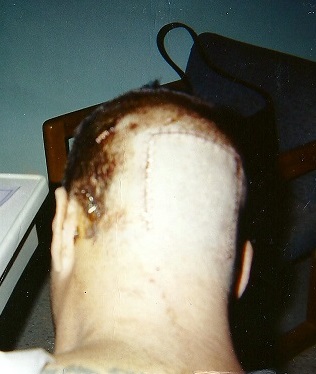
Head-shots, like felony arrests, have been a recurring theme over the first couple semesters of my life. When I was five years old, I had to be stitched up after running full speed into a wall in our apartment. Then there were seven years of head-on collisions in Pop Warner football, then juvenile hall lumps, prison yard lumps, a metal bar stool across the head in my mid-30sโ€ฆ But the most memorable concussion of my crash test dummy life was the car wreck that preceded the above photo. That’s not Frankenstein up there, that’s me. And those are 70 staples in my head.

Luckily there were no other cars involved. The roads were slick, my tires were bald, and my Pathfinder hydroplaned, flipped, and crashed through a fence, smacking an oak tree. The metal roof collapsed on my head.

I awoke two days later in the ICU of Sacred Heart Hospital. The neurosurgeon told my mom that I could be deaf, blind, slow, or paralyzed post-surgery, but that my brain was swelling and if he didn’t operate immediately, I would die.

That was 14 years ago and much has happened since: heartbreaks, hair loss, addiction, a lengthy prison sentence, and yes, more concussions. But in the midst of all this dreariness, something transformative has also occurredโ€ฆ books! And with these books, discipline, honor, maturity. I think even the most skeptical reader would concede that a brain-damaged, crackhead, ADHD high school dropout summoning the concentration to write full-length novels longhand is pretty unusual, if not miraculous. Sometimes I wonder if that near-fatal head injury back in 2002 caused some undeveloped part of my brain to light up and assist me in becoming a normal, fully functioning human being.

My third novel, On the Shoulders of Giants, is now available on Amazon. If you read it, you’ll find a character with a scar very similar to my own. This was done not only in adherence to the author’s axiom write what you know, but also as a tribute to my lifelong, toxic love affair with blunt force trauma and banging my head against things.

[This post originally appeared on malcolmivey.com 12/11/16.]