Skip to content

Botox for the soul

We’ve all known loudmouths. There’s one in every hood, every club, every schoolyard, every basketball court, every prison dorm. They’re everywhere, beating on their chests, threatening, bullying, shadowboxing, trumpeting their own toughness. And most of the time, we believe them. So it’s always surprising when someone comes along and knocks them on their ass. They were all form and no substance.

How about that dude who’s constantly spouting off about politics? He’s brilliant and he wants to make certain that you know he’s brilliant. What’s this guy even doing working a 9 to 5 job? He should be hosting Face the Nation. Yet when engaged in conversation with him, it becomes clear that he’s merely repeating the opinions of others, that he’s woven a mask from the words of Fox News analysts and talk-radio blowhards. And underneath there is no substance.

Have you ever met a beautiful person whose good looks were nullified by a selfish, shallow personality? An intellectual with no common sense? A loyal church-goer with no compassion? Form is vinyl siding; substance is a house’s foundation. Form is candy paint and chrome rims; substance is a V8 engine. Rippling muscle, hairpieces, tats, piercings, boob jobs: form. Courage, honor, faithfulness, 16-hour workdays during Christmas: substance.

Don’t get me wrong, I’m not bashing form. There’s something to be said for a nice body, a sparkling white smile, a sick tattoo. But if there’s no substance, then all the shiny outside stuff is basically expensive wrapping paper over a pair of tube socks.

How would I know? What qualifies me to speak on this subject? The short answer is: I’m a master of form. I am all of the above (minus the hairpiece and boob job) and after spending the better part of 40 years creating “the illusion of” instead of being, my chameleonic ways have left me feeling empty, phony, insubstantial. That’s what has led me on this fantastic journey of self-exploration, of spinal fortification, of reconciling inner with outer.

Form never lasts. Pretty words evaporate. Skin sags, teeth rot, hair eventually falls out. It’s inevitable. When I’m 90, do I want to be a miserable clot of fears and complaints and regret? Or a beacon of light? The relentless pursuit of character is Botox for the soul. Choose substance.

[This post originally appeared on malcolmivey.com 11/11/14 as “Form vs. substance”.]

Simplicity of kindness

I’ve been in a slump lately. I think it’s some kind of writer’s postpartum. Now that On the Shoulders of Giants is complete and in the editing phase, I don’t know what to do with myself. Without a working project, I feel adrift. Anchorless. And my old diversions only leave me hollow and unfulfilled.

So I was already grumpy when I sat down with the blind man this morning, but the USA Today Sports Weekly doesn’t come in Braille and I gave him my word. (Dude is a die-hard Braves fan. He listens to their games every night on AM radio. He’s also a baseball historian. Pretty amazing, really. Born blind and can still see the game in vivid detail. I never knew the difference between a sinker and a slider until he broke it down for me.)

I’m usually in awe of the blind man. Just the sound of his stick tapping the concrete will make me smile. He’s a good guy with good energy. Both are rarities in here. But today I wasn’t feeling it. I was wrapped up in my own problems. No book to consume me, no woman to love me, no rec yard, no mail, and a release date that is still thousands of days away. Me and my problems. Me me me.

But something happened as I began rattling off batting averages, OBPs, and ERAs to this guy who’s been in prison since 1986 and blind since birth. When I glanced up from the magazine and saw his unseeing eyes darting right and left, processing the information I was relaying, relishing it, I realized I was no longer annoyed. My heart was suddenly wide open, my troubles were forgotten, and in that moment, I was happy.

Why do I always forget this simple truth until it sneaks up on me? Nothing feels better than kindness. I need to practice it more often.

[This post originally appeared on malcolmivey.com in June 2016.]

10% Happier

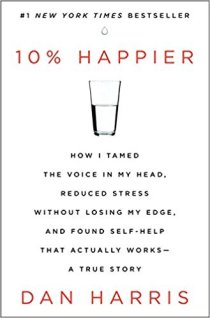
I just finished reading an amazing book, 10% Happier by Dan Harris. Mr. Harris is the ABC news correspondent who had a nationally televised panic attack on Good Morning America in 2004.  10% Happier is the hilarious account of his journey as both skeptic and seeker. It centers largely on the benefits of meditation. (I can almost see the five people reading this page rolling their eyes simultaneously.) While there is a definite unearned stigma attached to meditation, Iโ€™ll leave that for the holy men and gurus to sort out. No sermon here. Promise. I just want to touch on the parallel between meditation and writing.

If thereโ€™s such a thing as A.D.D., Iโ€™ve got it. I have the attention span of a butterfly which makes the discipline of writing a daily battle. Iโ€™ll be one or two sentences into a scene when something hooks my attention โ€“ a bird on a window, a voice in the hall, the smell of food โ€“ and Iโ€™m off โ€œchasing the wishes from dandelionsโ€ as my friend Sheena says.

As one distraction leads to the next, itโ€™s sometimes hours before I remember the project, only to find it right where I left it, suspended in mid-sentence โ€“ sometimes mid-word โ€“ so I grab my pen, search for the mental thread of the story and begin again. Itโ€™s the coming back thatโ€™s the thing.

Meditation is similar in that you focus on the breath flowing in and out of your nostrils, the expansion and contraction of your lungs. When thoughts arise and you notice yourself being swept away on that tidal wave of mental chatter, you return to your breath. Every time. Notice and return, over and over.

Iโ€™ve mentioned before that the discipline of writing saved me. Up until the year I began writing Consider the Dragonfly, life was all about drugs, gambling and adrenaline. The tendency to drift toward the extremes is scribbled in the helix of my DNA. But the written word is my anchor. Itโ€™s what centers me. The words on the page are the meditative breath that I keep returning to. My om.

Iโ€™m not claiming enlightenment or even rehabilitation. The distractions still come like Craig Kimbrel fastballs. All it takes is a Sophia Vergara commercial, a Black Crowes song or Miami Dolphins breaking news and I hit the ground running. But once I regain awareness and realize that yet again, Iโ€™ve been lured down the hallways of always, I shake my head and return to my work, to the open notebook that awaits me.

Itโ€™s the coming back thatโ€™s the thing.

[This post originally appeared on malcolmivey.com 6/15/14.]

The radical choice of militant kindness

The first lesson every young man learns upon entering the prison system is that aggression is king and violence is law. The traits that are valued in the real worldโ€”honesty, generosity, friendlinessโ€”are viewed as weaknesses in prison. Weaknesses that are pounced upon and exploited. Survival in this world depends on at least the perception of brutality and if you’re not particularly brutal, you had better be a damn good actor.

So that’s what I’ve been doing for the last 22 years. Acting. Acting tough, acting hard, acting cold. Acting as if I don’t see the loneliness and sadness and brokenness that surrounds me. Why? Simple: Fear.

In 1992, a scrawny teenage version of myself looked around at the savage world of prison and said to my mind, “Help! I don’t wanna be jumped or stabbed or raped or beaten to death by abusive guards. I wanna make it back home in one piece!” And my mind, amazing babbling problem-solver that it is, said, “I got this,” and went to work on building a wall and posting the ultra-sensitive ego as a sentry to ward off any potential threats. My job was to act. And act I did. I spent so much time acting that I almost lost myself inside the faรงade that was supposed to be protecting me. Almost.

But looking at prison through the eyes of a 40-year-old man is a much different experience than seeing it through the eyes of a scared little 18-year-old kid. And recently, after decades of fortifying this hardened exterior and living with a conditioned mindset that places toughness over all other attributes, a series of books, films, and extraordinary people have wandered into my life with an unmistakable message: there is nothing more honorable, more radical, more standup than the path of kindness. Especially in such a hopeless world.

Suddenlyโ€”no, not suddenlyโ€”gradually, I wanted this more than anything else. Militant kindness. Love without fear. A wide open heart. For someone who has spent years coveting the appearance of fearlessness and physical strength, the concept of kindness, regardless of consequence, was a revelation. A last shot at a life of meaning and authenticity. I wanted to get back to the me I was before all of this acting BS began, back to the kid I built these walls to protect.

Kindness. It seems like such an easy choice. But a crazy thing happens when you drop your guard and step from behind that icy standoffish barrier: people become comfortable around you. Comfortable enough to open up, to confide in you, and occasionally, comfortable enough to hurt you. Or at least say things that are damaging to your ego. But that is what we want, isn’t it? It’s what I want. This lonely half-life of keeping the world at arm’s length for a false sense of safety and to defend the ego is a fool’s game and the exhaustive struggle to continue propping up an illusion is not only cowardice, it’s treasonous.

Only kindness matters.

[This post first appeared on malcolmivey.com 10/30/14 and was featured on Huffington Post on 11/29/14.] 

Don’t be a lick

Do you know what a “lick” is? Not the generic definition. This has nothing to do with the tongue or fire or even defeating something. I’m talking slang here.

For those of you who have never tasted the misery of being enslaved by a chemical, a lick is what a drug dealer calls his customer. The guy who pawns his mother’s lawnmower for crack money is someone’s lick. So is the woman who sells her body for a 20 rock, or a shot of ice, or a Roxy 30. A drug dealer may pretend to like you, he may act oblivious to your rumpled clothing and declining weight, he may even chill with you for a while after money and merchandise are exchanged. But make no mistake, inwardly he’s smirking at your weakness. Regardless of the illusion of equal footing, this is not some business transaction. You are sick and desperate for what he has in his pocket, and he has all the power. You’re his sucker, his chump, his lick. Pointblank. He’s buying clothes and cars and bling while your life is crumbling all around you.

It’s humiliating to admit this, but I’ve been a lick for most of my life. As of this writing, I’m not even halfway through a 379-month prison sentence for robbing gas stations. Not because I was starving or because there was a recession and I was desperate to feed my family. No. I wish, but no. I was just a lick trying to scrape up money to bring to my dopeman. So you get it, right? Drugs are bad. I know what you’re thinking. “Thank you very much, Diane Sawyer, but this is not breaking news.” There are millions upon millions of stories out there about the soul-sucking consequences of drug abuse.

But this is not an anti-drug rant. This is an anti-lick rant. At the risk of sounding like the illegitimate child of Tipper Gore and Joe McCarthy, I’ll attempt to explain.

The predatory paradigm of dopeman and lick is not restricted to drug culture. It’s everywhere. Millionaire rappers laugh all the way to the bank while the kids who mindlessly, hypnotically repeat their lyrics get shot down in the streets, or come to prison with life sentences for trying to live out these murderous, unsustainable fairy tales that are being spoon-fed to them under the label of “cool.” Metal bands romanticize suicides and overdoses as if they were heroic acts. Violent video games, sexting, internet porn… it makes sense that kids are the biggest licks because they are the most inexperienced and therefore vulnerable. But it’s not just kids. Big Pharma is a billion-dollar industry. Middle Eastern turf wars are reported as ideological clashes but are really all about oil and who gets to sell it to us. Think we’re not China’s licks? Check out the “Made in” sticker on the back of any product sold at the local Super Walmart. Everybody wants a piece.

The Eagles have a terrific lyric in the song Already Gone: “So often times it happens that we live our lives in chains, and we never even know we have the key.” In this case, the key is awareness, knowledge, moderation. Don’t be a lick.

[Originally published on malcolmivey.com 11/20/14 as “The case for not being a lick”.]

Same as it never was

A couple of months ago, shackled and numb from a three-hour ride in a mobile sardine can, I watched through the steel mesh window as the first gun tower of my new prison appeared above the treeline.

And by “new” I mean “next,” my seventh institution in the last 12 years. There’s nothing new about this place. It’s at least 40 years old, maybe older. It’s not even new to me. Two decades ago, a skinny, gullible, wide-eyed 21-year-old version of myself arrived at this same prison.

Memories came flooding back as I hefted my property and shuffled off the bus into the light of day. Aside from a few fresh rolls of razor wire and different guards with the same scowls, everything was just as I left it, frozen in a perpetual state of 1994.

I looked toward the visitation park where Mom used to visit each weekend, ever faithful, ever believing, ever seeing the best in her son. She was in her 40s back then. She’s 70 now. Still faithful, still believing, still seeing the best in me. I have a lot to be grateful for.

Over the gray-wash shingles of the chapel that I helped to build, I could see the confinement unit looming. Somewhere in time, my younger self was still pacing those cells, nursing swollen black eyes and busted lips from fighting off wolves. Prison has extra challenges for young, skinny, blue-eyed white boys.

Beyond the confinement unit sprawled the rec yard where, once upon a nightmare, I sat cross-legged in the softball outfield, acoustic guitar in my lap, shielding my arm from the gun tower while an older convict shot me up with cocaine. Before my arrival in prison, I had only smoked pot and tripped acid.

The chow hall where I saw my first rat, the dormitory where I witnessed my first stabbing, the bunk where I got my first tattoo… These landmarks spread across the panorama like monuments to a darker, more confusing time. Though smaller and shabbier than the imposing dungeon of my memory, the prison is relatively unchanged. The only thing that’s changed is me.

I’m almost a quarter-century removed from the naรฏve and inexperienced kid who once roamed this compound seeking himself in the opinions and acceptance of others. That dark-haired, fresh-faced, 125-pound boy is now a bald, bearded, 200-pound man. I no longer confuse manhood with brutality and judge myself to be lacking. I treasure my loved ones instead of taking them for granted. I understand that fear is just a voice in my head. Discipline and a hunger for self-mastery have taken the place of addiction and impulsiveness. Then there’s the books…

T.S. Eliot once famously observed that “the end of all our exploring will be to arrive where we started and know the place for the first time.”

I’m not sure if I know the place any better, but I know myself and, in the words of another famous poet, “that has made all the difference.”

Finding peace without hope

Recent photo of J.G.A few years ago, I used to walk the track while pondering the cosmos with my homeboy JG at a private prison in the Florida Panhandle by the shady name of Blackwater (no relation to the infamous private-sector security firm that dominated the headlines in Green Zone Baghdad during the second Iraq war).

Although he was 15 years younger than I was, JG and I had a lot in commonโ€”same hometown, same circle of friends, both audiophiles, both sports fans, both committed to self-mastery and a life free from the enslavement of addiction. We were also both doing a substantial amount of time: him, 10 years; me, 30. But for all the things we had in common, there was a fundamental rift in our philosophies regarding the prison sentences we were serving and how we approached them.

JG is a Christian who is also well versed in The Secret, The Prosperity Bible and other new-thought, mind-over-matter, mustard-seed doctrine. His guiding principle is Biblical, Matthew 21:21-22 which, to paraphrase, says “Prayer and faith without doubt can wither fig trees and move mountains.”

While I don’t subscribe to any religion, I lean Eastern, spiritually, and call myself Buddhish. Herman Hesse’s Siddhartha has had a profound impact on my life. I’ve read Michael Singer’s The Untethered Soul three times, and We’re All Doing Time by Bo Lozoff has been a constant companion and manual to me for over a quarter-century in the chain gang. My guiding principle is straight out of The Four Noble Truths: Desire is the root of suffering and contentment is the way out.

Day after day, lap after lap, we debated our philosophies and invariably arrived at the same dead end. In a nutshell, JG believed that through prayer, visualization, and faith, he could will his way out of prison long before his distant release date. I believed that through meditation, gratitude, and acceptance, freedom could be attained right here, right now, regardless of my release date.

We hit a stalemate. He thought it was cowardly of me to accept my conditions without a fight. I thought he was naรฏve to believe in the impossible. In the end we had to agree to disagree. I was in my tenth year of incarceration at the time and he was on only his second. Sooner or later he would come to the realization that hope hurts and learn to find peace in the present moment without clinging or resisting.

Fast forward two and a half years. We had both been transferred to different prisons, and I was so immersed in writing the final scenes of On the Shoulders of Giants that the only time I departed the story world of Izzy and Pharaoh was to eat, sleep, and shower. So I was shocked when I called home one day and my mom told me that JG had won his appeal. It was all over Facebook.

That night as I lay in my bunk, I thought about JG and Blackwater and all those afternoons spent walking the track and debating the power of faith vs. the freedom in acceptance. Guess he won that argument.

But since then I’ve been wondering, have I robbed myself of miracles by failing to expect them? Would I be home right now if I hadn’t tapped out and surrendered to my circumstances? Are desire and contentment really mutually exclusive? Maybe there is a Tao between these two polarities, a middle road that allows for both ambition and inner peace.

I won’t say that JG’s release caused a radical shift in my belief system, but it did inspire me to open my mind, adjust my philosophy, and leave a little room for hope… at least a mustard seed’s worth.

A shining example

white-house-paintingBlame it on George Orwell. He once said that itโ€™s impossible to enjoy the writings of someone with whom you take political issue. For this and other reasons, I decided to steer clear of politics in 2017. I even made it a New Yearโ€™s resolution. I consider my novels to be letters to the world and want these posts to read the same way. I thought this year I would include more humor, more story, more music. But like many Americans, Iโ€™m already backsliding on my resolutions, three weeks in.

For this I blame another George: Stephanopoulos. Last weekend I watched him stroll around the White House with President Obama for a final interview, and as the outgoing Commander-in-Chief answered each question with the same poise and equanimity that have been the hallmarks of his tenure in the Oval Office, I knew I had one more political post to write.

I campaigned for President Obama in prison visitation parks in the Deep South. I spent much of 2008 convincing mothers and fathers of lifers that the Supreme Court justices and lower appellate court judges that he would potentially appoint could one day mean freedom for their sons. Or at least provide hope. He did not disappoint. Eight years later he leaves the job as the biggest criminal justice reformer in the history of the White House.

He was also the most gifted orator. Certainly, of my generation. Over and over I watched him run circles around his opponents in presidential debates (horses and bayonets, anyone?). He did it with humor too. Remember the press dinner in the lingering aftermath of the birther allegations? He had the band strike up โ€œBorn in the USAโ€ and came out pumping his fist like Springsteen. His State of the Union speeches were honest and engaging. His presidential addressesโ€”especially after tragedies such as Sandy Hook, the Boston Marathon bombings, and the Dallas police murdersโ€”conveyed hope and healing to a heartbroken nation.

But it wasnโ€™t just words. It was action too. Despite being hamstrung for three-quarters of his time in office by a partisan Congress that needed him to fail, he still managed to tame a gluttonous Wall Street, rescue American icons Ford and Chevy from the brink of extinction, steer us out of an economic crisis that cost the world 40 percent of its wealth, and commute the disparate sentences of hundreds of war-on-drugs prisoners.

Oh yeah, he also got Osama Bin Laden.

However, his legacy will not and should not be tied solely to this historic hit on Americaโ€™s most notorious enemy. But rather to the kindness, tolerance, and humanity he displayed over the last eight years. Just how kind was he? Well, I wrote him a letter and he wrote me back. Think about that. Amid all the global tension, intelligence briefings, and thousands of voices clamoring to be heard, the leader of the free world took the time to respond to a prisoner.

Critics will point to the ACA as a failure. Maybe. Millions of Americans who are now insured would probably disagree. I have no voice in this debate. As a prisoner, my health care expenses are limited to the five-dollar copay Iโ€™m charged each time I visit the clinic. I do believe that no idea is born fully formed and eventually, some future administration, possibly the new one, will iron out the kinks in Obamacare, repackage it, and present it to the American people as a glowing success.

Critics will also point to race relations as a failure. On this I vehemently disagree. Because of President Obama, the issue of race is no longer the elephant in the room. Itโ€™s a hot button issue. A water cooler issue. And people from all walks of life are expressing their opinions. If there is ever to be a united America, it has to start with an open line of dialogue. His polarizing presence in the White House alone has nudged us into having these uncomfortable conversations.

But the main reason I admire our 44th president has nothing to do with diplomacy or policy or statecraft. During one of the darkest periods of my life, as I tried to claw my way out of the immense hole I had dug for myself, President Obama was a shining example of what leadership looks like, what self-mastery looks like, what manhood looks like.

I found this quote from Michelle Obama scrawled in the journal I used while writing my second novel, With Arms Unbound. Itโ€™s from the 2012 Democratic National Convention in Charlotte. โ€œEven in the toughest moments, when weโ€™re all sweating it, when all hope seems lost, Barack never lets himself get distracted by the chatter and the noise. He just keeps getting up and moving forwardย .ย .ย . with patience and wisdom and courage and grace.โ€

I hope that one day, when I leave the world of prison behind, my future wife will hold me in similar regard.

I know this election season has been vitriolic and divisive. Despite our new presidentโ€™s numerous faux pas, head-scratcher cabinet appointments, and thin-skinned cringe-worthy tweets, I do not wish him failure. To wish him failure is to wish America failure. At minimum, Iโ€™m hoping jobs continue to grow under his stewardship. His entrepreneurial chops could well prove to be a huge asset for the country. But no matter how prolific Donald Trumpโ€™s triumphs, Barack Obama will be a hard act to follow.

Since this has to end somewhere, Iโ€™m thinking a good place would be where the journey began: on a Tuesday night in November 2008, Grant Park, Chicago. After an historic landslide victory over John McCain, a younger, less gray president-elect put the following question regarding change to the spirited crowd of thousands: โ€œWhen are we going to realize that WE are the ones weโ€™ve been waiting for?โ€

Eight years, three novels, and a couple of miracles later, I can point to that speech as a major turning point in my own journey. Thanks for the inspiration, Mr.ย President. I canโ€™t speak for the rest of the nation, but in my little corner of captivity, you will be missed.

The solution

Given what happened in Chicago over the weekend, a continuation of rampant violence that barely makes the news anymore, I wanted to repost this piece I wrote a few months ago. Unfortunately, it’s still relevant.ย 

The Middle East โ€“ Sunnis and Shiites murdering each other. For territory, for power, over ideology. Death tolls rise along with the level of hopelessness. Every day, violence is a fact of life to which the citizens of places like Baghdad and Aleppo have become desensitized. There is no place too sacred for bloodshed. No mosque, no school, no hospital. In addition to sectarian violence, children have grown up watching their cities and villages bombed by foreign drones, their families and neighbors killed or taken away by foreign soldiers. Flames of hate are fanned by radical clerics. An insidious โ€œus vs. themโ€ mentality seeps into the soul of the people.

The fear and distrust flow both ways, feeding off each other. Too many soldiers have watched their comrades fall to IEDs and sniper fire. Too many service members have witnessed the carnage of suicide bombings.

America โ€“ Drug pushers and gang members murdering each other. For territory, for power, for street cred. Death tolls rise along with the level of hopelessness. Every day, violence is a fact of life to which the citizens of places like Chicago and Oakland have become desensitized. There is no place too sacred for drive-by shootings. No church, no park, no school bus stop. In addition to gang violence and inner city drug wars, children have grown up having their doors kicked in by narcotics officers, seeing their neighbors slammed on car hoods, electrocuted by tasers, sometimes murdered by police, their fathers and brothers taken away in cop cars, often never to return. Flames of hate are fanned by ratings-driven news channels, through bullhorns of activists, and the microphones of rap stars.

The fear and distrust flow both ways, feeding off each other. Too many cops have seen their comrades murdered in the line of duty, in shootouts and chases, and more recently in cold blood, executed over their uniforms.

There is no simple fix to this complex and generational problem. A congressional hearing wonโ€™t solve it. Nor will any new law. The American way of throwing truckloads of tax dollars at the situation wonโ€™t make it go away either. But there is a solution: Love.

Donโ€™t roll your eyes. Naรฏve and idyllic as it sounds, if every pastor, teacher, mentor, and concerned citizen formed a government-backed coalition, a movement to ensure that every inner city kid in America is loved, nurtured, and taught respect for human life, 20 years from now, we would see a major downscale in violence, hate, and intolerance.

This is no hippy-liberal, peace-and-love idea. It takes balls to go into high-crime areas and mentor children. Volunteers could be robbed, shot, raped, murdered. But we have missionaries and aid workers traveling to the Middle East every day. Kayla Mueller, a young American Doctors Without Borders worker in Syria who was kidnapped and eventually killed by ISIS, said: โ€œFor as long as I live, I will not allow this suffering to be normalโ€ฆโ€ Her same heroic philosophy needs to be aimed at Americaโ€™s inner cities.

โ€œGreat idea, Malcolm. So why donโ€™t you do it?โ€

Because Iโ€™m in prison. But from this side of the razor wire, things are crystal clear. My dormitory is full of 19-year-old kids with life sentences. Unraised, uneducated, unloved. Many of them left children behind who will grow up the same way. These are young men who laugh at domestic terror attacks and applaud when police are gunned down. As cold-blooded and evil as this sounds, itโ€™s a problem that will continue to grow exponentially if not confronted at its roots. Not with force and intolerance, but with love and compassion.

In my latest novel, On the Shoulders of Giants, a story that deals largely with race, there are three sections titled โ€œThe Other America.โ€ But the truth is, there is no โ€œother America.โ€ Thereโ€™s only one America. No them, only us. Itโ€™s time to start investing in ALL of our children.