Skip to content

For Mom

I electrocuted myself when I was a second-grader in Catholic school. I was in the principal’s office for fighting Ryan Balthrop and thought it would be cool to jam a paper clip in an electrical socket while I waited. Something to pass the time. I vaguely remember convulsing against the wall, then being spat across the room, crashing into a nun’s desk like a meteor with my hair standing straight up and every line and seam on my palm burnt to a crisp. When my mom skidded into the Saint Pius parking lot, she was crying harder than I was.

This would become a recurring theme in our lives: me self-destructing and Mom suffering. When I hit 13 and went to juvie for the first time, Momma cried. When I was sentenced to prison at age 18, Momma cried. When I showed up at visitation with black eyes from fighting, or dilated eyes from dope, or sunken eyes from months in solitary confinement, Momma cried. And when I finally came home after ten years, Momma cried.

But just because she cried doesn’t mean she’s weak. My mom is a soldier. The strongest lady I know. Imagine witnessing your only son waste away on crack cocaine, finding him on your porch at 3 a.m. emaciated, dirty, begging for money. Only you don’t see the zombie that the world sees. You see the little boy that you rocked and read bedtime stories to and drove to football practice. Imagine arriving at Sacred Heart Hospital after learning he totaled his car and having the ER surgeon explain that if he performs brain surgery now, your child could be deaf or blind or slow, but if he doesn’t, he’ll be dead within hours. Imagine sitting by his bed in ICU, stroking his stapled head. The face you had so much hope for now vacant. Defeated. Swollen and bruised from police flashlights and boots. The same flesh you once bathed and diapered and swaddled in blankets now ripped to ribbons by police dogs. Imagine sitting in the courtroom, helpless, as a federal judge sentences him to 31 years in prison.

This story could have easily ended right there. But Mom wouldn’t let it go. She forced the issue. She continued believing in me, despite my track record of personal failure. She kept willing me forward when I thought the fight was long over, kept driving to every prison in the state to visit me, kept seeing the best in me, kept calling me on my shit when I was slipping, kept loving me for some cosmic maternal spiritual reason that only mothers and God understand.

Then one day in 2010, I asked her if she would type something for me… This became what is now the first chapter of Consider the Dragonfly. Eight years and four novels later, we’re still going strong and my old life seems like someone else’s nightmare.

I believe the stories I tell are relevant. And obviously, I hope they are entertaining. I do my best to illustrate the human condition with heart, humor, and unobtrusive prose. But the real story may be the process. I write the scenes and chapters longhand from my bunk, then six pages at a time I mail them home to Mom who lovingly types every F-bomb, every fight sequence, every overdose, then sends them back to me for revisions, which are made during 15-minute collect calls, all under the jaundiced eye of one of the nation’s more abusive and intolerant prison systems. This is the story behind the stories, the journey of a crash-dummy son and the mother who refused to give up on him.

Poor Momma. As hard as it’s been on her in real life, it’s been even worse on the page. After Consider the Dragonfly, people wondered if she killed herself. Then after On the Shoulders of Giants, many assumed she was a junkie. Now that Sticks & Stones has been out for a few months, people have been discreetly inquiring about her late-stage Alzheimer’s. She’s likely Kenny from South Park โ€” next book she’ll probably get hit by a truck. There’s a reason for this: memorable fiction is not about what goes right, but what goes wrong. And the most catastrophic thing that could happen in my world is something happening to Mom.

People also confuse me with my characters. I guess this is fair since they’re all convicted felons. If I had to select one that I relate to the most, it would be Izzy from On the Shoulders of Giants. Like him, I feel like writing gives me an identity other than failure, loser, career-criminal. But unlike Izzy, I’ve been fortunate enough to experience some positive return on energy. My novels have been mentioned in Writers Digest magazine, my hometown paper ran an article about me, I even received a personal letter from President Obama… but the crowning achievement of my writing life is that the lady I once habitually let down, humiliated, and made cry is now able to slide these books to other county retirees and fellow master gardeners and say with pride, “My son is a writer. This is his latest novel.”

Happy Mother’s Day.

Christopher vs. Malcolm

Thirteen years ago today a skinny, strung-out, zombified version of me staggered into a Circle K with a stolen pistol demanding Newports, Optimos, and all the cash in the register. An hour later, police K-9s found me hiding in a field off 9 Mile Road. The dog bites were bad enough to require stitches. The next morning, I was released from the hospital and booked into the now-condemned central booking and detention unit of the Escambia County jail. I remember scouring the floor for pieces of crack and scanning the ceilings for a place to hang myself. Good times. And there was reason to believe things weren’t going to get much better.

Friends faded, the Feds indicted me, the state was pushing for life imprisonment. I ended up getting 379 months. I was 31 years old at the time. This sentence meant it would be another 31 years before I breathed free air again. Sorta like a life sentence with a little daylightโ€ฆ if I made it that far. Once in prison, I immediately reverted to my old patternsโ€”getting high, gambling, and living unconsciously.

There is a Bob Seger lyric from Against the Wind that I have always loved. “The years rolled slowly past. I found myself alone. Surrounded by strangers I thought were my friends. Found myself further and further from my homeโ€ฆ” Soundtrack of my life. Things were getting consistently worse.

Then in 2009, in the midst of a nine-month stint in solitary confinement, it occurred to me what a colossal mess I’d made of my life. And by occurred, I mean it fell on me like an imploding building. I was 35 years old with no home, no property, no career, no pension, no children, no freedom, no future, and no legacy except for the lengthy criminal record that dated back to my 13th birthday. I had to do something to turn the momentum. Quitting dope was a good start but it wasn’t enough. I needed to rebuild myself. This is where the books come from. A few years, four novels, and one miraculous Supreme Court ruling later, my entire life has changed. Saved by the craft.

There is a scene in my latest novel, Sticks & Stones, where a skinny, hollow-eyed crackhead walks into a convenience store and pulls a gun on the petrified clerk, a scene very similar to a chapter of my own life. Except in this story, the protagonistโ€”an ex-convictโ€”steps forward to stop the robbery. A monumental struggle ensues. This is bigger than just two men battling it out on the page. This is good versus evil, past versus future, Christopher versus Malcolm.

Spoiler alert: The good guy wins.

The opinionated voice in my head

I don’t know about you, but my brain came equipped with a paranoid, self-conscious backseat driver who is constantly bumping his gums about every catastrophic and humiliating potentiality that is mathematically possible in a given situation.

This is probably part of the reason why I continued getting high long after the party was over — silencing the inner noise, separating self from brain chatter. Although sometimes this backfired and the dope was like giving the voice in my head a bullhorn.

But this isn’t another of my anti-drug rants. I don’t even consider myself anti-drug. I just can’t use them. For me, drugs come with the curious side effect of landing in the back of police cars. In fact, I’m currently 11 years into a 30-year sentence for actions resulting from my voracious, insatiable appetite for mind-altering substances. But again, this is not about the drugs. This is about the voice.

If you’re thinking “Malcolm is a psycho, he’s got a voice in his head,” that would be the same voice I’m referring to. We’ve all got it. This highly opinionated, ultra-sensitive, threat-assessing, judgment-casting inner narrator who edits the inflow of the world through the senses with various degrees of inflection. Mine happened to be squawking this morning. I’ll explain…

I’ve been wanting to try yoga for a while, ever since I read Bo Lozoff’s We’re All Doing Time. I’ve been incarcerated for most of my life and I grew up hanging from the pull-up and dip bars on rec yards across the state of Florida. These sorts of exercises are a given, as routine as chow and count. There’s a reason why your crackhead nephew gets arrested skinny enough to hide behind a pine tree, and gets out with pecs like Lou Ferrigno. We get buff in here. It’s part of the prison experience.

Yoga has a different draw: flexibility, supple internal organs, reduced stress, increased energy, focus, concentration, peace of mind. At 42 years old, these things seem more important to me now than having massive biceps. So this morning I woke up, brushed my teeth, slammed a bottle of water, and settled into the Corpse pose in the space beside my bunk.

Almost immediately, the voice piped up: “You look weird, man.” I ignored it and climbed to my feet to attempt the sun salutation. The voice was silent for a moment, but by the time I reached downward dog, it was back with a nervous vengeance: “Dude, what the hell? People are staring. They’re gonna think you’re soft or gay or crazy.” The voice was right. Yoga postures aren’t exactly the most prison-friendly exercises. The last thing I wanted was some rapist checking me out while I attempted the plow.

I couldn’t help it. I opened an eye and surveyed the dorm. The guy across the aisle was zoned out on psych meds, another had toothpaste slathered over his face, the old man behind me was in a heated debate with an invisible opponent. No one was paying any attention to what I was doing.

I had to laugh at myself. Why was I sweating appearances when I live in a crazy house? Probably because my paranoid backseat driver convinced me yet again that my reputation, manhood, and very existence depended on it. Here’s hoping your voice is more laid-back than mine.

[This post originally appeared on http://www.malcolmivey.com in June 2016.]

The Behemoth and the Snowflake

They say that upon finishing a manuscript, writers should do something outside their comfort zone. Learn a foreign language, pick up a musical instrument, take a cooking class. Something that causes a different part of the brain to light up. I chose to learn Silat, an Indonesian fighting style that focuses on blocks, strikes and grappling.

The dude whoโ€™s teaching me is my polar opposite. A 330-pound, former powerlifter, military historian, ex-bouncer, Limbaugh-loving, NRA conservative who is always talking about the liberal media, fake news, and politically correct safe-space snowflakes.

Full disclosure: I think Iโ€™m a snowflake. Especially if that means Iโ€™m into human rights, civil rights, common sense gun legislation, clean water, clean air, and kindness. I even have a letter from President Obama in my photo album. Doesnโ€™t matter. Through Silat, this neo-con behemoth and I seem to have found common ground, and after a little over a month of drilling, training, and sparring, I am excelling at the art.

It feels good to be excelling at something because lately Iโ€™ve been questioning my ability as a writer. My Amazon author ranking is hovering around two million (are there even two million authors in the world?). Literati industry snobs ignore my existence and, worst of all, my magnum opus, my Pillars of the Earth, my lifeโ€™s work and beautiful child, On the Shoulders of Giants, has failed to place in a single contest this year. Crushing. I knowโ€ฆ I sound like a whiny snowflake. Whatever.

So it was with a fair amount of hesitance that I passed my novel to this gruff, Fox News defensive tackle. I would have never considered doing so had he not already proven to be extremely intelligent and well readโ€ฆ almost to the point of arrogance. I wanted to earn his respect.

He smirked when he accepted it. โ€œYou wrote this?โ€ I knew I was setting myself up for failure. On the Shoulders of Giants is a novel about race, addiction, lost love, gun violence, foster care and the Arthur G. Dozier School for Boys. Even the title is a nod to a famous President Obama speech. Not exactly required reading for Republicans. To further lengthen the long odds of his acceptance, dude is a sci-fi fan. I had already spotted Frank Herbertโ€™s Dune series stacked on his bunk. Our literary tastes are as diametrically opposed as our politics. The question was not so much would he like the book? as it was would he finish it? Apparently my sadomasochistic snowflakery knows no bounds.

In the ensuing days, I watched him from across the dorm. Heโ€™s about as rough on a novel as you would expect from a sausage-fingered, powerlifting grizzly bear; dog-earing pages, folding the book back on its spine, setting his morning coffee on the cover. About midway through, we were sparring one day when I asked him how he liked it so far. He rolled his eyes. โ€œLaden with white guilt.โ€ But he read on.

It took less than a week for him to knock it out. One night he came and sat on my bunk, coffee-stained, dog-eared novel in hand. โ€œYou know,โ€ he said, โ€œwhat happened to Scarlett wasโ€ฆโ€ He couldnโ€™t finish his sentence. โ€œDid you like it?โ€ I asked. Tears streamed down his face. All the answer I needed. I placed a hand on his massive back. Humbled. Honored. Screw the contest snubs and academic cold shoulders. This guyโ€™s emotional response was all the accolade I needed. A supreme compliment from the unlikeliest of readers.

And, by the way, itโ€™s Mister Snowflake to you. Donโ€™t forget, I know Silat.

A transformative craft

โ€œIf your life were a book, would you like your character?โ€

These words have been nibbling at my conscience for years, surfacing at the most inopportune timesโ€”while cheating on a girlfriend, stealing from a family member, cooking cocaine in a spoonโ€ฆ The answer was always the same: โ€œNo, I would not like my character. I would hate my character.โ€

There are few things in this world as unsustainable and soul-sucking as drug abuse. This is far from breaking news. The hard math states that someone in your orbit is suffering right now, be it your child, sibling, significant other, friend, neighbor, co-worker or yourself. For most, the needle and the crack pipe are a life sentence of enslavement. However, there are exceptions. Some find Jesus, others escape through a 12-step program, and I would never underestimate the healing properties in the love of a woman. But for me, the way out was through the written word.

When I first beganย Consider the Dragonflyย I did so in desperation. It was a Hail Mary, a half-court buzzer beater, my last shot to escape the quicksand of my old patterns and do something honorable. The universe gave me the bonus plan. Barely a few pages into the first chapter, the characters shimmered to life. Protagonists and antagonists whispered backstory into my heart, explaining why they were the way they were, confiding secrets and fears and dreams, drawing me deeper into the world of story. And while I was busy being a conduit, head down, scribbling furiously, a sort of alchemy was taking place in my own world. Impulsivity was converted to discipline. Recklessness was exchanged for structure. I was suddenly protective of my remaining brain cells and mournful of those I had squandered. The craft was changing me.

There is something empowering about writing a novel, something spiritual about plugging into the collective consciousness and transcribing the flow of words from the ether, something transformative. Iโ€™ve been clean for a few years now. My second book,ย With Arms Unbound, will be outย this summerย and Iโ€™m presently knee-deep in a new project. Some will say that Iโ€™ve merely swapped addictions. Maybe so. Iโ€™m cool with that. Because today when that old question pops into my headโ€”โ€œIf your life were a book, would you like your character?โ€โ€”the answer is a resounding “Hell yeah!”

[This post originally appeared on malcolmivey.com 6/1/14 as “Writing: A transformative craft”.]

Think of yourself as a nation

There is a villain in my second novel, With Arms Unbound, with the unfortunate name of Festus Mulgrew. Heโ€™s a meth cook from central Florida with a pet spider named Junior and a problem making eye contact. Like any decent villain on the page or the screen, Festus wasnโ€™t born bad. There are reasons why he is the way he is. But that doesnโ€™t make him any less dangerous. If anything, his humanity makes him even scarier, or at least more believable.
I canโ€™t do the mustache-twirling bad guy any more than I can do the square-jawed, puppy-saving hero. Iโ€™ve never met anyone like that. My heroes are flawed and my villains have at least a couple of redeeming qualities. Just like in real life.

When sketching the character of Festus โ€œMethlabโ€ Mulgrew, in addition to giving him a backstory rife with abuse and abandonment, I gave him a personal philosophy for survival under harsh conditions. That philosophy is also my own. The difference is that while Festus used it in a negative way, it has helped me to quit drugs, adhere to a strict workout regimen, manage money, develop discipline, be assertive, and focus long enough to write a few books.

If anyone within the sound of this pen is struggling with self-mastery, this may help: Think of yourself as a nation. I am the United Federation of Malcolm Ivey and like any other sovereign country, I am composed of the following:

~ Borders: These are my boundaries. Thou shalt not cross.
~ Allies: My homeboys. Every nation has alliances.
~ Enemies: Other hostile nations. In my world there are many.
~ Military: My defense system. Keep strong and confident through regular exercise and stand ready to protect my borders and allies against any threat.
~ National Debt: The money I owe.
~ GDP: The money I earn.

You can even give yourself a national bird and your own anthem if you want. The point is to take a hard look at all the various agencies that make up your nation and ask yourself if theyโ€™re being run efficiently. We ultimately have the power to mold ourselves into nations with robust economies, plentiful natural resources, and solid foreign relations. We can eliminate our deficits, strengthen our alliances and win our wars. Whether we choose to be a super power or a third world country is entirely up to us.

[This post originally appeared on malcolmivey.com 07/31/14.]

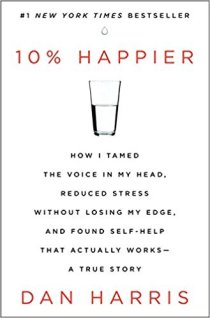
10% Happier

I just finished reading an amazing book, 10% Happier by Dan Harris. Mr. Harris is the ABC news correspondent who had a nationally televised panic attack on Good Morning America in 2004.  10% Happier is the hilarious account of his journey as both skeptic and seeker. It centers largely on the benefits of meditation. (I can almost see the five people reading this page rolling their eyes simultaneously.) While there is a definite unearned stigma attached to meditation, Iโ€™ll leave that for the holy men and gurus to sort out. No sermon here. Promise. I just want to touch on the parallel between meditation and writing.

If thereโ€™s such a thing as A.D.D., Iโ€™ve got it. I have the attention span of a butterfly which makes the discipline of writing a daily battle. Iโ€™ll be one or two sentences into a scene when something hooks my attention โ€“ a bird on a window, a voice in the hall, the smell of food โ€“ and Iโ€™m off โ€œchasing the wishes from dandelionsโ€ as my friend Sheena says.

As one distraction leads to the next, itโ€™s sometimes hours before I remember the project, only to find it right where I left it, suspended in mid-sentence โ€“ sometimes mid-word โ€“ so I grab my pen, search for the mental thread of the story and begin again. Itโ€™s the coming back thatโ€™s the thing.

Meditation is similar in that you focus on the breath flowing in and out of your nostrils, the expansion and contraction of your lungs. When thoughts arise and you notice yourself being swept away on that tidal wave of mental chatter, you return to your breath. Every time. Notice and return, over and over.

Iโ€™ve mentioned before that the discipline of writing saved me. Up until the year I began writing Consider the Dragonfly, life was all about drugs, gambling and adrenaline. The tendency to drift toward the extremes is scribbled in the helix of my DNA. But the written word is my anchor. Itโ€™s what centers me. The words on the page are the meditative breath that I keep returning to. My om.

Iโ€™m not claiming enlightenment or even rehabilitation. The distractions still come like Craig Kimbrel fastballs. All it takes is a Sophia Vergara commercial, a Black Crowes song or Miami Dolphins breaking news and I hit the ground running. But once I regain awareness and realize that yet again, Iโ€™ve been lured down the hallways of always, I shake my head and return to my work, to the open notebook that awaits me.

Itโ€™s the coming back thatโ€™s the thing.

[This post originally appeared on malcolmivey.com 6/15/14.]

Magical No. 9

I’ve always had a thing for the number 9. When I was a kid, there was a local graffiti artist who used to tag it all over South Miami. I remember riding in the back of our family car and seeing it spray-painted on bus stops and the sides of businesses. Once I was conditioned to look for it, the number began popping up everywhere. Highlighted on taxicabs, gas station price signs, and math homework assignments.

When I was 18 (1+8=9), I came to prison and discovered Coast to Coast with Art Bell on AM radio. One of his guests was a numerologist who spent an entire segment on the number 9, pointing out its unique properties, relating it to the Mayans and ancient mathematicians. It was like he was talking about my childhood friend.

My life is full of 9s. My mom had me when she was 27 (2+7=9). Her mom had her when she was 18 (1+8=9). When the universe blesses me with a love interest and I find out her birthday, my mind instantly begins its calculations (“7/5/1984: 7+5+1+9+8+4=34 and 3+4=7. Damn. Almost. If only she’d been born in September.”). When my nieces and nephews turn 9, they get a long, rambling card from me pointing out the magic of the age and encouraging them to make the most of it. Many of the cell numbers and dates that appear in Consider the Dragonfly and With Arms Unbound are nods to 9. There’s a full-blown tribute to the number via the character Scarlett McGhee in On the Shoulders of Giants.

So of course, 2016 was destined to be a gigantic year (2+0+1+6=9) and after a sluggish start, it is now surpassing expectations. My third novel is in the pipeline, the Miami Dolphins drafted Laremy Tunsil, With Arms Unbound received Honorable Mention in the Writer’s Digest magazine novel competition, and a recent Supreme Court ruling may reduce my release date from 2032 (don’t bother, it’s 7) to 2025 (2+0+2+5=9) and it’s only May! Good ol’ 9. What’s your favorite number?

[This post originally appeared on malcolmivey.com 5/22/16 as “Magical number 9”.]

E = mc2

My fatherโ€™s father was a writer and the son of a philanthropist. His name was E. Malcolm Collins, II. I never met him but his novel,ย Angel Blood,ย was a permanent fixture on the bookshelf in our apartment when I was growing up.

The story passed down through the family was that he was an alcoholic and drug abuser, and in December 1971, he ran a bath of scalding hot water, stepped in, slipped and banged his head. He died in the tub. He left behind one daughter, my Aunt Carole, who also struggled with alcoholism and depression, and one son, my father โ€œMac,โ€ E. M. Collins, III, who had his own issues with drug abuse and compulsive behavior.

In 1990, Aunt Carole checked into a hotel room and shot herself in the heart. Three and a half years later, my father died of congestive heart failure, a lifetime of Camel non-filters and horrible eating habits finally caught up with him. Aunt Carole had two daughters: Kelly and Ginger. Mac had four sons: Scott, Keith, Jeff, and me.

Not to air any dirty family laundry, but I think deep down my brothers and cousins would agree that thereโ€™s a little crazy swimming in our DNA; a compulsive gene, a predisposition to addiction, maybe even a touch of psychosis. But thereโ€™s also an overwhelming amount of love and music and laughter.

September 5thย is the 21st anniversary of my fatherโ€™s death. Itโ€™s hard to believe that over two decades have passed since the prison chaplain gave me the news. At age 40, I can see the evidence of his genetic fingerprints all over my life, and not just in my evaporating hairline or the blue eyes staring back at me in the mirror. I recognize him in my passion for sports, my own struggles with drug abuse, my love for the Blackjack tables in Biloxi, my affinity for cheesecake. There are signs of E. M. Collins II, in me too, and his father, and the echoes of countless generations before them.

When I began writing novels, I took on the pseudonym Malcolm Ivey as a nod to those men: Malcolm I, II, and III, the philanthropist, the writer and the banker. The “Ivey” represents the Roman numeral IV, Malcolm the fourth, my fatherโ€™s son to the bone and the youngest of four brothers. Ivey.

On September 5th, I will raise a bottle of water to my reflection and salute the Malcolms in me, blemishes and all. As Albert Einstein put it, โ€œEnergy cannot be created or destroyed, it can only be changed from one form to another.โ€ I drink to that.

[This post first appeared on malcolmivey.com 9/1/14.]